1-580 CE
The Kartlians were the people of eastern Georgia who built the kingdom of Iberia in the valleys of the Kura and Mtkvari rivers, adopted Christianity a generation after Rome did, and held their mountain crossroads between Persia and the steppe for centuries.
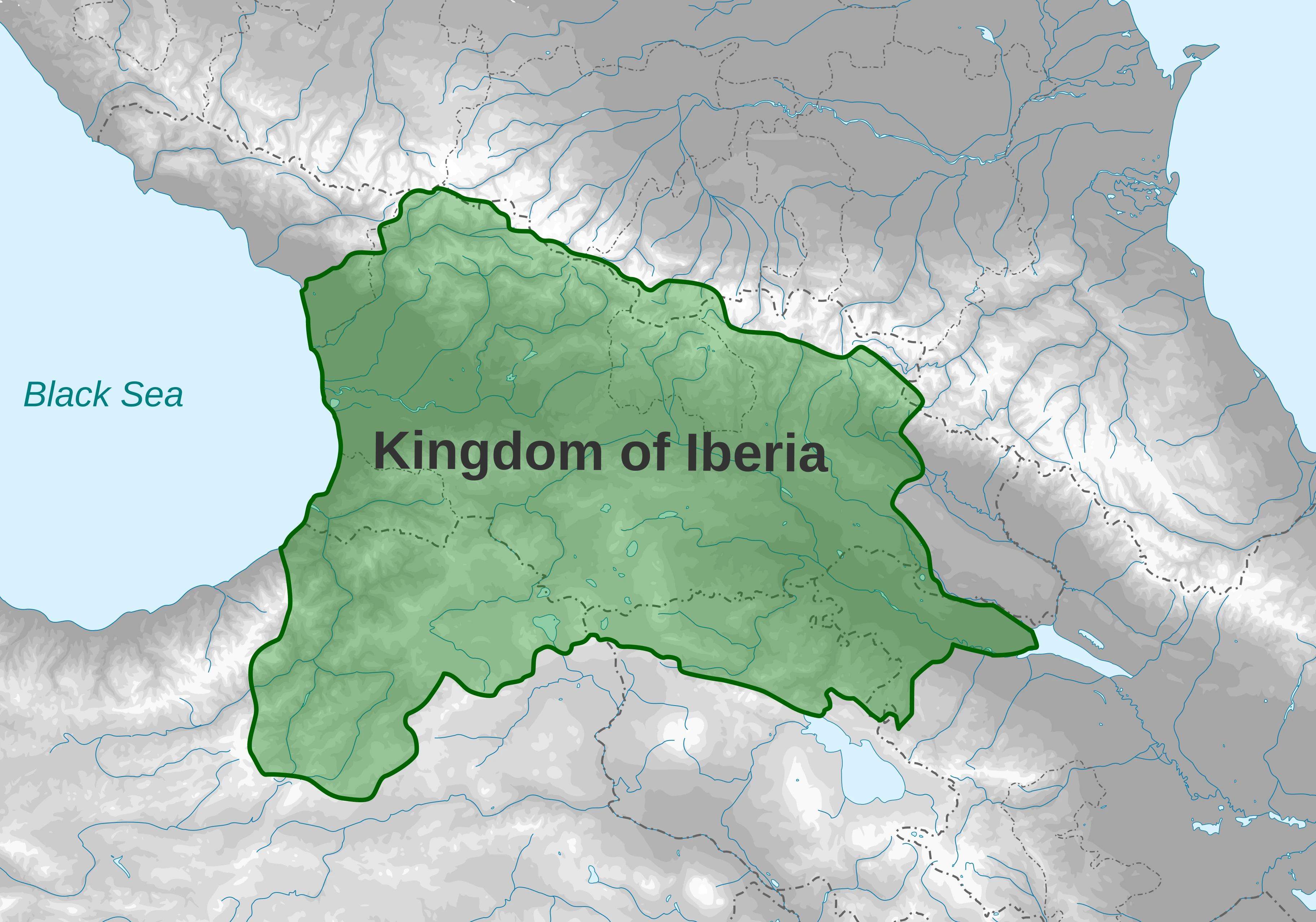
The Kartlians were the Kartvelian-speaking people of eastern Georgia who gave their name to the kingdom of Kartli, known to the classical world as Iberia. The coincidence of name with the Iberian peninsula is exactly that: a coincidence. Greek geographers applied the label independently, possibly from a shared root meaning "land" or "people" in different contexts, and the two Iberias had no connection beyond the confusion they have caused students of ancient geography ever since.
Kartli occupied the fertile valleys where the Kura and Mtkvari rivers meet, shielded by the Greater Caucasus to the north and the Lesser Caucasus to the south. The kingdom's western neighbor was Colchis, later Lazica, the land the Greeks associated with the Golden Fleece. Whether the Colchians and Kartlians were originally the same people who diverged or related peoples who converged is unclear, but by the first centuries of the common era they shared enough language and custom to be recognized as part of a broader Kartvelian world.
The Kura valley was fertile ground: well-watered, temperate, and sheltered enough to support vineyards, orchards, and grain fields. Georgia's claim to be one of the oldest wine-producing regions on earth rests on archaeological evidence going back millennia, and the Kartlians of the classical period cultivated grapes with an intensity that impressed visitors from both the Roman and Persian worlds. A farmer burying a clay kvevri, a large egg-shaped vessel, in the ground to ferment wine was practicing a technique unchanged from the Bronze Age.
Villages clustered along the river valleys and on terraced hillsides. Stone was the building material of choice, and Kartlian houses were solid, thick-walled structures designed for cold mountain winters. The capital, Mtskheta, sat at the confluence of the Kura and Aragvi rivers, a natural meeting point that had been settled long before any kingdom existed. Above the town rose the fortress of Armazi, and from its walls a garrison could watch both river approaches and the mountain passes that led north through the Caucasus to the steppe.
Kartli's strategic position was both its value and its curse. The kingdom controlled passes through the Caucasus that connected the steppe world to the fertile lands of the south. Every major power in the region wanted those passes, and Kartli spent its entire history balancing between larger neighbors. Rome and Persia competed for influence, and Kartlian kings learned to play one against the other with considerable skill, accepting subordination to whichever empire was currently stronger and reasserting independence whenever the balance shifted.
The Kartlian army was small but competent, built around a nobility that fought as heavy cavalry and a peasant levy that provided infantry. Mountain terrain favored defense, and the passes could be held by determined garrisons against much larger forces. But the open valley floor was vulnerable, and when Sassanid Persia decided to impose direct control in the late fifth century, the kingdom lacked the military weight to resist. Kartli became a Persian province governed by a marzban, and the royal dynasty was set aside.
Kartli adopted Christianity in the 330s, making it one of the earliest kingdoms to do so. The traditional account credits Saint Nino, a captive woman from Cappadocia, with converting the royal family through miraculous healings. The story may be simplified, but the date and the direction of influence are generally accepted: Christianity reached Kartli from the Roman world and took root among the elite before spreading to the broader population.
The church became central to Kartlian identity in a way that went beyond religion. Monasteries served as schools, scriptoria, and administrative centers. The Kartvelian alphabet, one of the oldest in continuous use, developed in connection with the translation of Christian texts into Georgian. A monk at the Jvari monastery overlooking Mtskheta, copying a psalm into the angular Asomtavruli script, was participating in a project that defined his people's literary culture. When Persian pressure threatened to impose Zoroastrianism, Christianity became the marker of Kartlian distinctiveness, the thing that separated them from their overlords and connected them to a wider Christian world.
Kartli traded with both the Roman and Persian worlds. Wine, textiles, and metals moved south and west; Persian luxury goods, spices, and silk moved north and east through the Caucasian passes. The kingdom's position on the edge of the Silk Road routes brought wealth but also attention. Armenian, Greek, Persian, and eventually Arab influences all left marks on Kartlian art, architecture, and court culture.
The loss of political independence to Sassanid Persia did not destroy Kartlian identity. The church held the culture together during the centuries of foreign rule, and when political circumstances allowed, new Georgian kingdoms emerged with their sense of distinctiveness intact. The Georgian literary tradition, the Orthodox faith, the wine culture, the stone architecture adapted to mountain terrain: all of these trace continuous lines back to the Kartlian kingdom in the Kura valley. Mtskheta remains a pilgrimage site and a symbol of national origin, the place where a captive woman from Cappadocia is said to have changed the course of a people's history.

 of your religion


 without your City or Castle, if you have the most influence there and there is your
In the game, the Kartlians govern through monasteries. Religious communities grant influence, control provinces without cities, and faith cubes feed themselves back from every bag draw. Choose your religion in the first round but try to be the last player to do so, picking a faith unique at the table. This prevents opponents from stealing your religious communities. Prioritize meaderies and spreading religion above everything else.
Yes. You have +1 influence in every religious community of your religion, regardless of who controls that community. Control and influence bonus are separate.
Yes. Whenever you draw white cubes from the bag for any reason, including spreading religion, you may transfer them to your religion card up to your faith cube limit.
If you have the most influence in a province and there is a religious community of your religion there, you control that province even without a city or castle. This grants all normal benefits: glory and coins during the achievement phase, and it counts as yours for achievements and abilities.
Yes, you still have +1 influence there, because it remains a religious community of your religion. However, you cannot use your fourth ability to control that province, because heresy causes you to lose control of the religious community. Since the community is no longer one you control, the province-control ability does not apply. You would need a city or castle there to control the province normally.
From your supply. You discard all your faith cubes (minimum 1), then take 1 cube of your color from your supply and add it to the battle bag.
No. The ability says you may add faith cubes into the bag, OR discard all your faith cubes to add 1 cube of your color. You choose one option per battle, not both.