1-476 CE
The Romans built the largest and most enduring empire the Mediterranean world had ever seen, governing from Britain to Mesopotamia through law, roads, legions, and a genius for absorbing conquered peoples into a shared civilization.
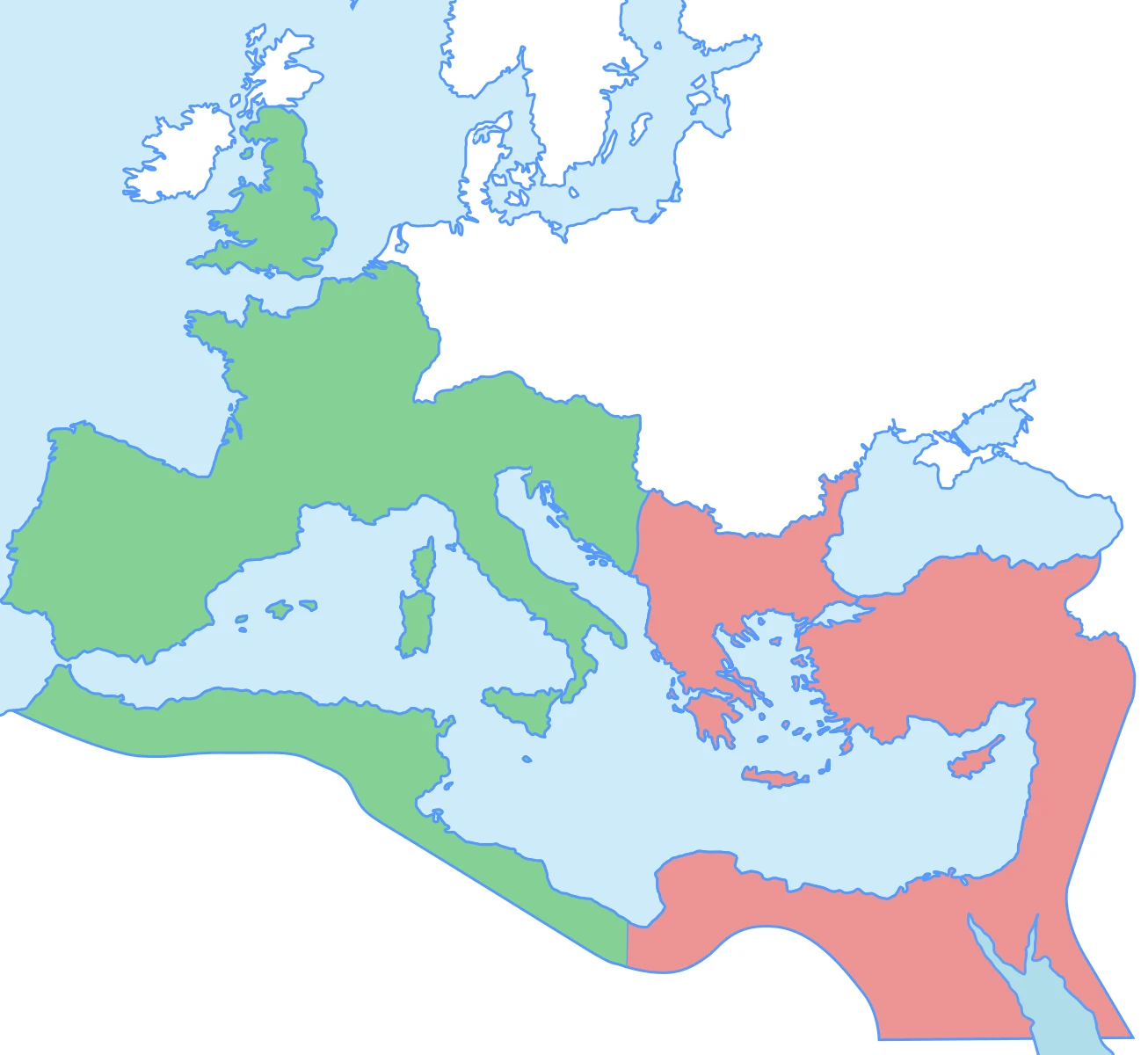
By the first century CE the Romans were no longer an ethnic group in any meaningful sense. They were a legal category. A Roman citizen could be a grain merchant from Egypt, a cavalry officer from Spain, a philosopher from Syria, or a farmer from Gaul. What bound them was not blood but membership in a political system that had spent five centuries expanding from a single city on the Tiber to an empire encircling the entire Mediterranean. The citizenship that had once belonged only to men born within sight of the seven hills was extended, step by step, until Caracalla's edict of 212 granted it to virtually every free person in the empire.
This universalism was the Roman genius and, eventually, a Roman problem. An empire that could absorb anyone could also be transformed by everyone it absorbed.
The empire contained every landscape from Scottish moorland to Saharan oasis, and daily life varied accordingly. But certain patterns held across provinces. Roman towns followed a common plan: a forum, a bathhouse, a market, a temple or two, streets laid on a grid. Even a small provincial town in Pannonia or Britannia had public baths where a laborer could wash after work, heated by a hypocaust system that pushed hot air beneath the floor. A man scraping oil and dirt from his skin with a curved bronze strigil in a bathhouse in Trier was performing the same ritual as his counterpart in Antioch.
The countryside fed the cities through a network of estates worked largely by enslaved labor. A villa rustica in southern Gaul might have dozens or hundreds of enslaved workers tending vineyards, pressing olives, and firing pottery. The owner, often an absentee living in the nearest city, collected rents and profits through a bailiff. Grain from Egypt and North Africa fed Rome itself; Spanish olive oil traveled in amphorae stamped with the producer's name. The economy was extractive, efficient, and dependent on forced labor at every level.
The Roman legion was the most effective military institution of the ancient world, and it stayed effective for centuries by adapting. The heavy infantry of the Republic gave way to the more flexible imperial legion, which combined foot soldiers, cavalry, artillery, and engineers into a single formation. A legionary carried a gladius for close combat and two pila, heavy javelins designed to bend on impact so they could not be thrown back. The pilum's iron shank punched through shields and rendered them useless, forcing the enemy to fight unprotected against the disciplined Roman line.
By the fourth century the army had changed again: smaller mobile field armies replaced the old legionary garrisons, and Germanic recruits filled the ranks in growing numbers. The empire's military problem was not any single defeat but the impossibility of defending every frontier simultaneously. Troops pulled from the Rhine to fight in Persia left a gap that Germanic war-bands exploited. The western empire did not fall to a single catastrophe but wore down over decades of civil war, fiscal collapse, and incremental loss of territory until the last emperor was deposed in 476.
Roman religion was originally a system of public rituals performed on behalf of the state rather than a matter of personal belief. A priest sacrificing a bull at an altar was conducting a transaction with the gods: offerings in exchange for protection. Private devotion attached itself to household spirits, local deities, and imported mystery cults from the east. Christianity, one such import, grew slowly through the second and third centuries before Constantine's conversion in the early fourth century made it the empire's favored faith.
Society was rigidly hierarchical: senators, equestrians, free citizens, freedmen, and slaves occupied distinct legal categories with different rights, punishments, and expectations. A senator convicted of a crime faced exile; a slave faced the cross. Yet social mobility existed. A freed slave could become wealthy, and his grandson could enter the equestrian order. A woman spinning wool in a workshop in Ostia might be enslaved, freed, or freeborn, and her legal status determined everything from whom she could marry to whether her children belonged to her or to her owner.
Roman trade reached China along the Silk Road; Roman coins have been found in Vietnam and southern India. Within the empire, a road system built for military logistics became the infrastructure of commerce. Goods moved faster and more reliably across the Roman world than they would again until the eighteenth century. A letter sent from Rome could reach Britain in three weeks.
The western empire's collapse in the fifth century did not erase Roman civilization so much as fragment it. Roman law survived in the legal codes of every successor kingdom. Latin evolved into the Romance languages. The Catholic Church preserved Roman administrative structures, and bishops in Gaul and Spain governed their dioceses using boundaries drawn by Roman provincial maps. A farmer plowing a field in Provence in the sixth century walked behind an ox on a road the legions had paved, past a bridge Roman engineers had built, toward a church that stood on the foundations of a Roman temple. The empire was gone, but the landscape it had made persisted.


 to draw that many cubes from the bag. For each cube of your color, deal 1 damage to an enemy target; discard any remaining cubes


 of one type, pay -2

In the game, the Romans combine garrison infrastructure with industrial efficiency. An extra Barracks from the start means legions are always ready. Spending weapons before battle represents the pilum volley, javelins hurled to shatter shields and thin enemy ranks before the lines close. Production costs less coin because slave labor was cheaper than anyone else's workforce. A free Swordsman on turn one means Rome does not wait.
You start the game with one Barracks already in place, without placing a building token on the map. This Barracks generates 1 coin in taxes each round like any other building. It also allows you to recruit military units as if you had an additional Barracks. If you build all remaining Barracks from your player board, you will have the normal maximum plus one. The virtual Barracks cannot be destroyed or removed.
Yes. The discount applies per production of one type. If you produce cloth and weapons in separate actions, you get -2 coins on each. In the first Age this often makes production nearly free in terms of coins, since you rarely produce more than 2 units of one type at a time.
Yes. After the ability resolves, the normal battle procedure continues, including determining the winner. If all enemy objects have been destroyed, you win the battle.
Both abilities trigger "after bag preparation," but the defender resolves all their "after bag preparation" effects before the attacker. If you are attacking, the defender's abilities happen first.
Yes, but your cubes need to be in the bag for it to work. Even without military units, you may add action or experience cubes to the bag during preparation, then use this ability to draw and deal damage with any cubes of your color drawn.