700-1066 CE
The Vikings were Norse seafarers from Scandinavia who burst onto the coasts of Europe in the late eighth century, raiding monasteries and river towns with a speed that no kingdom could match, then settling, trading, and building states from Dublin to Kyiv.
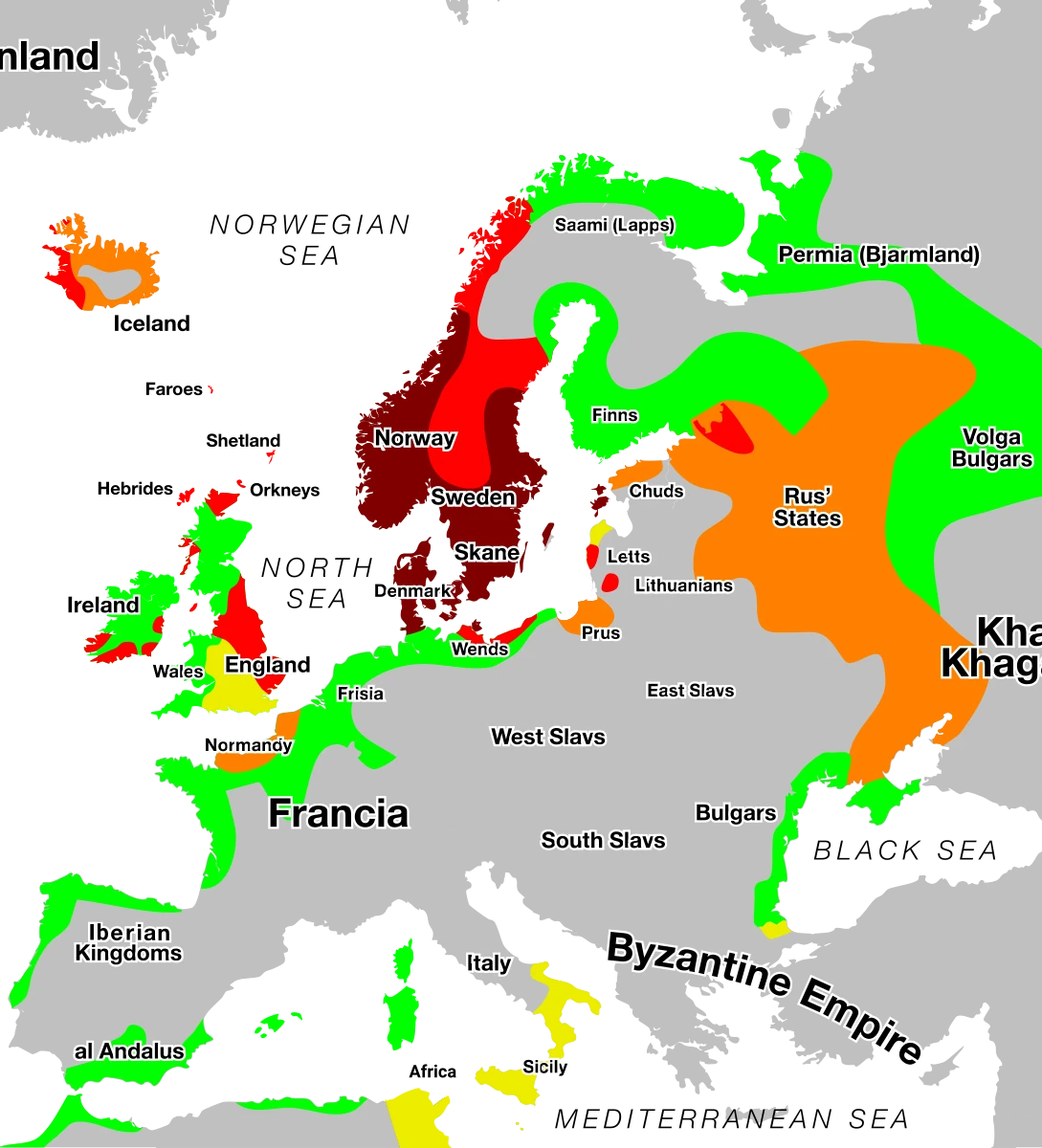
"Viking" was a job description before it was an identity. The Old Norse word probably meant something like "one who goes on an expedition," and the men who rowed out of Scandinavian fjords in the late eighth century were farmers, younger sons, and opportunists who raided in summer and went home for the harvest. They came from Norway, Denmark, and Sweden, spoke related dialects of Old Norse, and shared a shipbuilding tradition that gave them the fastest, most seaworthy vessels in the world.
The raid on Lindisfarne monastery in 793 announced them to a horrified Christian Europe, but Scandinavians had been trading and exploring the North Sea and the Baltic for generations before that. What changed was scale, ambition, and the realization that the monasteries and river towns of western Europe were rich and poorly defended.
Scandinavia was a hard country: long winters, short growing seasons, thin soil except in the Danish lowlands and a few sheltered Norwegian valleys. Barley and oats grew where anything grew at all. Cattle and sheep grazed summer pastures in the uplands. Fishing and sealing supplemented the diet everywhere. A farm in western Norway might have a single strip of plowable land between the mountain and the fjord, and the fjord was often the easier way to make a living.
The longhouse was the center of life: a timber-framed hall with a central hearth, turf or thatch roof, and benches along the walls that served as seats by day and beds at night. Smoke hung below the rafters. In winter a family might not see the sun for weeks, and the hall became workshop, stable, and world. A woman managed the household, held the keys to the storerooms, and could divorce a husband who displeased her. Textile production was constant: every farm needed wool spun, woven, and sewn into clothing and sailcloth.
The longship made everything possible. Shallow-drafted enough to beach on any shore or navigate a river, yet sturdy enough to cross open ocean, it carried thirty to sixty men who served as both crew and raiding party. There was no distinction between sailor and warrior. A man pulled an oar for twelve hours and then stepped ashore with an axe. Speed was the tactical principle: arrive before the enemy can assemble, take what is portable, leave before reinforcements come.
As raiding matured into conquest, Viking armies grew larger and stayed longer. The Great Heathen Army that invaded England in 865 came to take land, not loot, and its leaders carved out kingdoms. But the same individualism that made Vikings effective raiders made them poor empire-builders. Alliances fractured, chieftains quarreled over spoils, and conquered territories were divided among rival leaders. The Norse states that endured longest were the ones that adopted local administrative practices: the Danelaw in England, Normandy in France, the Rus principalities along the Dnieper.
Norse religion had no temples in the Christian sense and no professional priesthood. Sacrifices were made at outdoor sites, sacred groves, or inside the hall itself. The gods were practical figures: Odin traded an eye for wisdom, Thor protected ordinary farmers from chaos, Frey ensured fertile fields and healthy livestock. A farmer pouring ale onto the ground before plowing was performing the same kind of transaction he conducted at market: something given, something expected in return.
Death was the occasion for display. A wealthy man might be buried in his ship with weapons, tools, food, and sometimes a sacrificed slave. A poorer man got a simpler grave but still went into the ground with his knife and a brooch. The sagas, written down centuries later in Iceland, preserve a culture that valued quick wit as much as physical courage, and where reputation was the closest thing to immortality. A man's name survived in the stories people told about him, and a good death was worth more than a long life.
The reach of Norse activity is staggering. Norwegian settlers colonized Iceland, Greenland, and briefly touched North America. Danish armies conquered half of England and extracted tribute from the rest. Swedish traders and warriors followed the rivers of Rus' south to Constantinople, where they served as the Varangian Guard of the Byzantine emperor. Norse merchants traded walrus ivory, furs, and slaves for Arab silver, Byzantine silk, and Frankish swords. A silver dirham minted in Baghdad could end up in a hoard on a Swedish island, carried there along a chain of river portages and market towns.
The Viking Age ended not because the Norse were defeated but because they were absorbed. They converted to Christianity, married into local dynasties, adopted the languages and laws of the places they settled, and became Normans, Rusyny, Icelanders, English. The last major Viking invasion of England ended at Stamford Bridge in 1066, three weeks before the Norman conquest that was itself led by descendants of Norse settlers. The Vikings did not disappear. They became everyone else.

 in a battle, gain 1
  , or 2 if the enemy
  was larger

 has +1 strength if it is adjacent to the sea, and +1 courage
if adjacent to the ocean
adjacent to sea / ocean, you may spend
2
has +1 strength if it is adjacent to the sea, and +1 courage
if adjacent to the ocean
adjacent to sea / ocean, you may spend
2  to gain 1 exhausted
  on that hex


 for each destroyed enemy object
In the game, there is no such thing as a pointless Viking battle. Lost units earn glory, especially against larger armies, so even a doomed attack writes a saga worth telling. Destroyed enemy objects pay 5 coins each, and victories near the coast spawn new vessels from scavenged timber. Do not hesitate to attack superior forces: the glory from losses often outweighs the military setback, and the plunder funds your next assault.
An object is either a unit or a structure. You gain 5 coins for each enemy unit destroyed and 5 coins for each enemy structure destroyed during the battle.
Army size refers to the number of units in the army, including peasants, not total influence or HP. Size is determined at the start of the battle, before any casualties. If the enemy army was larger when the battle began, you receive +2 glory per lost unit regardless of how casualties change relative sizes during combat.
You may gain any vessel type available to you, including elite vessels if you have the ability to recruit them. The vessel is placed on the hex with an exhaustion cube already on it, meaning it cannot move until the next round when exhaustion is removed.
Yes. If your land army is adjacent to a sea hex and also adjacent to an ocean hex, it receives both bonuses: +1 strength and +1 courage.
No. The ability specifies "in a battle." Units lost to adversities, events, or other non-battle effects do not trigger the glory gain.