1-885 CE
The Armenians were a highland people of eastern Anatolia and the southern Caucasus who built one of the oldest continuous civilizations in the Near East, adopted Christianity before any empire did, and held their identity through centuries of partition between Rome and Persia.
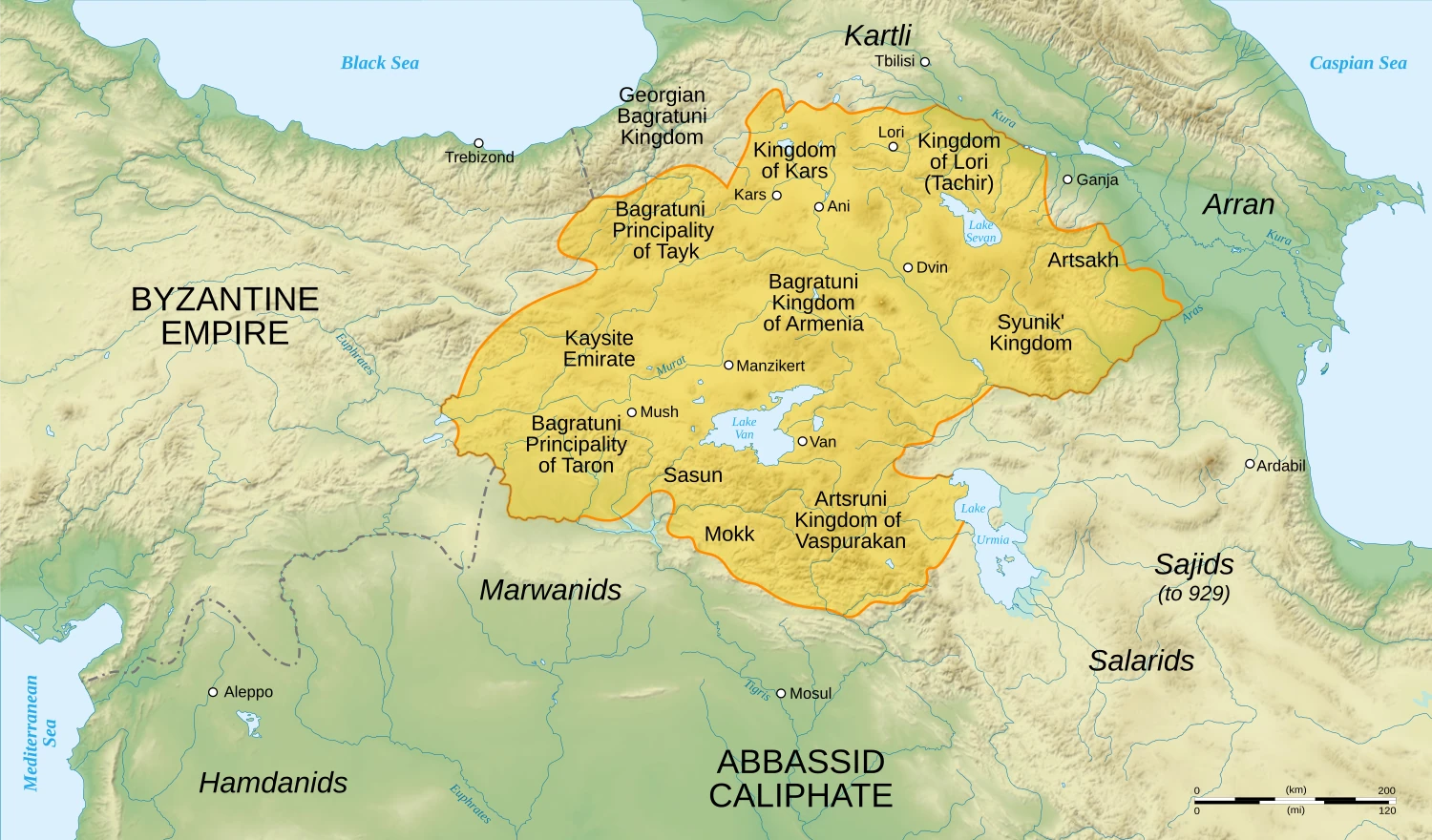
The Armenians occupied the high plateau where eastern Anatolia meets the Caucasus, a landscape of volcanic peaks, deep river gorges, and cold winters that has been continuously inhabited for millennia. Their roots reach back to the kingdom of Urartu, which flourished around Lake Van in the ninth through sixth centuries BCE and left behind stone fortresses, irrigation canals, and cuneiform inscriptions that the Armenians later inherited without being able to read. Whether the Armenians descend directly from the Urartians or arrived as a separate Indo-European-speaking group that absorbed the older population remains debated, but the continuity of settlement on the same highland ground is not in question.
By the first century CE, Armenia was a kingdom squeezed between Rome and Parthia, valued by both empires for its strategic position and trusted by neither. This would be the defining condition of Armenian political life for the next thousand years.
The Armenian plateau sits at an average altitude of 1,500 meters, high enough for bitter winters and short growing seasons but blessed with fertile volcanic soil in the river valleys. Wheat, barley, and lentils grew in the lowlands. Vineyards and orchards occupied the south-facing slopes. Apricots, which the Romans called the "Armenian fruit," were cultivated here long before they reached the Mediterranean. Livestock grazed the upland pastures in summer and came down to sheltered valleys in winter.
Villages were built from the dark basalt and tufa stone that the volcanic landscape provided in abundance. A typical Armenian farmhouse was a stone-walled structure with a flat or domed roof, partly dug into a hillside for insulation. In winter the family shared the lower floor with livestock, the animals' body heat warming the rooms above. A woman grinding wheat on a stone quern in a house near Erzurum in the third century worked in a building style and a daily routine that would have been recognizable to her descendants a thousand years later.
Armenia's geography made it defensible but not impregnable. The mountain passes could be held, and invading armies struggled with altitude, cold, and supply lines stretched thin across rough terrain. But the plateau itself was open enough for cavalry warfare, and Armenian nobles maintained a tradition of heavy mounted combat that made them valued allies and dangerous enemies. The nakharar system, a hereditary nobility whose great families controlled specific territories and owed military service to the king, provided the kingdom's military backbone.
The weakness was internal. The nakharars were powerful enough to resist royal authority, and the competition between them gave both Rome and Persia leverage to intervene. Armenia was formally partitioned between the two empires in 387, with the larger eastern portion falling under Sassanid control. The Armenian Arsacid dynasty lingered in the east until 428, when Persia abolished it entirely. For the next four and a half centuries Armenia had no king, governed instead by Persian marzbans and later by Arab emirs, yet the people and their institutions survived.
Armenia adopted Christianity as a state religion traditionally dated to 301, making it the first kingdom to do so. The conversion is credited to Gregory the Illuminator, who persuaded King Tiridates III after, according to tradition, the king spent years imprisoned in a pit for persecuting Christians. The story has the quality of hagiography, but the early date of Armenian conversion is well established. The church became the single most important institution in Armenian life, outlasting every dynasty and every foreign occupation.
In the early fifth century, the monk Mesrop Mashtots created the Armenian alphabet, a system of thirty-six letters designed specifically for the Armenian language. The alphabet made possible a flood of translations from Greek and Syriac, and original Armenian literature followed. The Bible translation produced by Mashtots and his students was so precise that scholars later used it to reconstruct lost Greek texts. A scribe copying scripture in a monastery near Lake Van in the sixth century was working in a tradition barely a hundred years old, yet already mature enough to produce works of lasting scholarly value.
Armenia's position between empires made it a corridor for trade, ideas, and armies. The Silk Road passed through or near Armenian territory, and Armenian merchants became intermediaries between the Roman and Persian commercial worlds. Armenian architects developed a distinctive stone building tradition, with churches featuring centralized domed plans that influenced both Byzantine and later Caucasian architecture. The church of Zvartnots, built in the seventh century, was ambitious enough to impress the Byzantine emperor Constans II when he visited.
The loss of political independence did not diminish Armenian cultural vitality. The church, the alphabet, and the network of monasteries preserved identity through centuries of foreign rule. When an independent Armenian kingdom finally re-emerged under the Bagratid dynasty in 885, it drew on traditions and institutions that had survived unbroken since the conversion. The Armenians' ability to endure partition, conquest, and occupation without losing their language, faith, or sense of peoplehood is among the more remarkable stories of cultural persistence in the medieval world.

 has +1 strength in your


 /
/  , gain faith cubes up to your limit


 warehouses


 , after bag preparation, you may add any number
of faith cubes to it
, after bag preparation, you may add any number
of faith cubes to it
In the game, the Armenians channel an ancient faith into every aspect of survival. Military and cultural research feeds your faith reserves, white cubes drawn from any bag become resources, and faith cushions the blow when overcoming adversity. Vote for events that inflict adversities, especially those that weaken opponents. Overcoming those adversities generates the faith cubes that fuel everything, and converting them into resources keeps your economy running on prayer.
No, only in religious communities you control. If another player shares your religion and controls some communities, you do not receive the strength bonus there. You must control the religious community yourself.
Faith cubes dilute the bag, improving your odds. When you draw white cubes, including faith cubes you added, you do not pay for them as you would for black cubes. This makes overcoming adversity less costly.
You convert the drawn white cubes into resources by placing them on your resource warehouses. Each white cube becomes one resource of the type you place it on.
Yes. You can distribute them however you choose: 1 wood, 1 stone, 1 food, for example. You are not required to place all on a single warehouse.
Yes. The ability says "after researching / adopting a military or culture technology." Both researching and adopting qualify, so you gain faith cubes up to your limit in either case.