200-734 CE
The Frisians were master sailors and traders who dominated North Sea commerce from villages built on artificial mounds above the tidal marshes between the Rhine and the Weser.
The Frisians were coastal Germanic people who lived on the tidal flats and salt marshes of the North Sea and turned that unpromising ground into the commercial backbone of early medieval northern Europe. Other peoples measured wealth in land. Frisians measured it in ships and the knowledge of shallow waters that swallowed anyone who did not know them.
Their flat-bottomed vessels could cross open sea yet slide through channels where deeper-hulled ships stuck fast, and this gave them a near-monopoly on the trade that moved between Scandinavia, the British Isles, and the river systems of the continent.
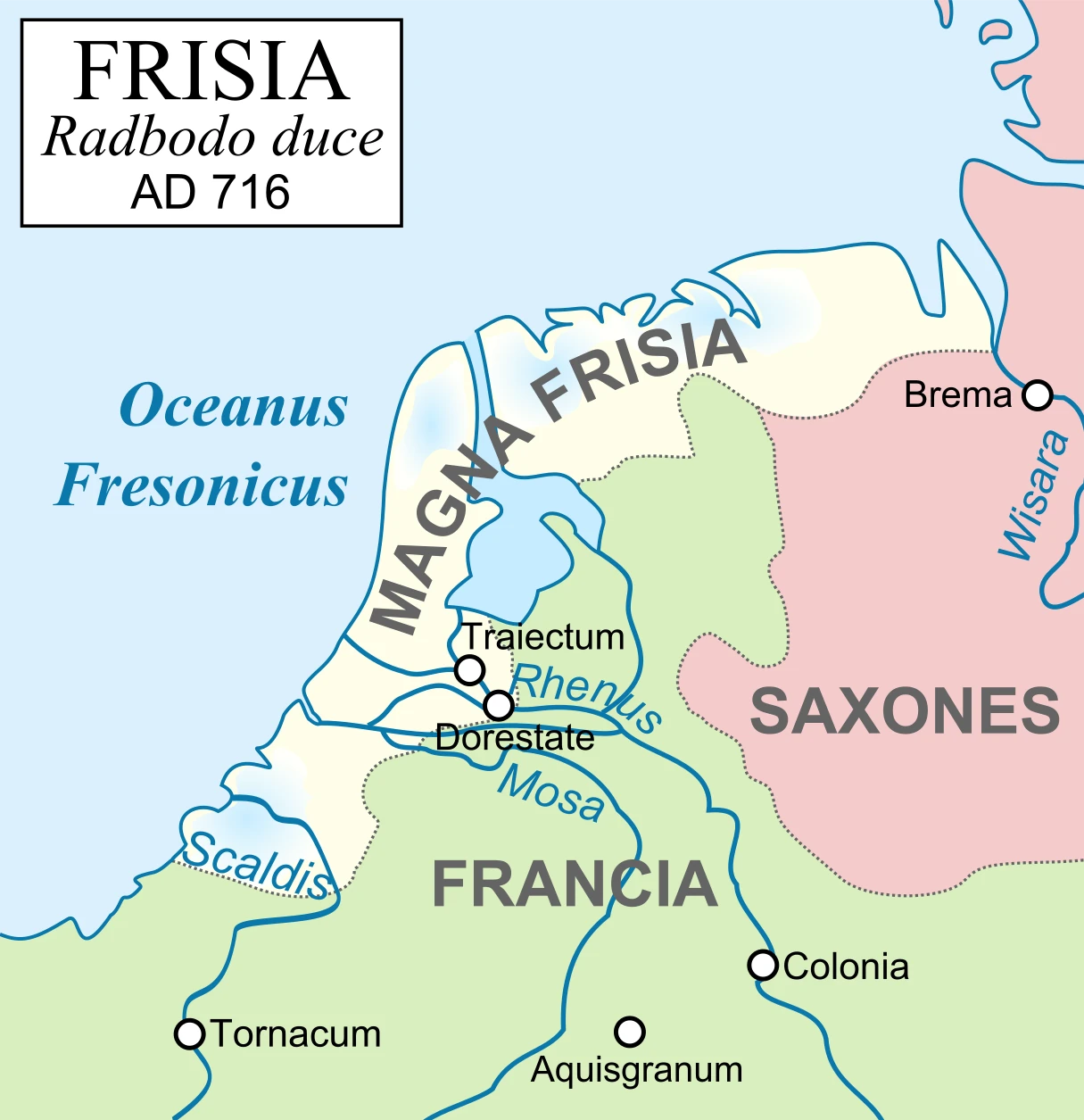
Their country stretched along the North Sea coast from the Rhine delta north to the Weser, a ribbon of barrier islands and waterlogged soil that the Romans had looked at and largely left alone. Families lived on terps, artificial mounds of packed clay raised three or four meters above flood level, each one housing a longhouse, cattle byres, and workshops. From above the landscape looked like a constellation of inhabited islands scattered across endless wetland, connected by water rather than roads.
What seemed worthless to farmers proved valuable to traders: every ship sailing between Scandinavia and Francia passed through waters the Frisians knew by heart.
The Frisians were pragmatists before they were fighters. Their scattered settlements could never muster the massed infantry of the Franks, and when Frankish kings demanded tribute, Frisians usually calculated that paying was cheaper than bleeding. Their real defense was geography. The marshes swallowed cavalry, the tidal flats trapped unfamiliar ships, and any conqueror who burned a Frisian port discovered that the trade simply moved to the next stretch of coast, carried by the same flat-bottomed boats.
King Radbod, the last ruler of an independent Frisia, held the Franks at bay for a generation around 700 before his kingdom was finally absorbed. According to a story that later chroniclers loved to repeat, Radbod stood at the baptismal font, one foot in the water, and asked where his dead ancestors were. In hell, said the missionary. Radbod pulled his foot out. He would rather be in hell with his kinsmen than in heaven with a handful of Franks.
Life on a terp followed the tides and the trading calendar. Spring sent the ships out, summer brought salt-making and the arrival of foreign goods, autumn meant the return of merchants and the slaughter of cattle that could not be fed through winter. Women managed the terp households, which could include dozens of people and hundreds of animals. A Frisian wife was accountant, provisioner, and often trader in her own right when her husband was at sea. Children learned to swim almost before they could walk.
The old gods received offerings at coastal shrines, and Christianity came not through persuasion but through Frankish military pressure and the stubbornness of foreign missionaries. Willibrord, an Anglo-Saxon monk who had been given Utrecht as his base, spent decades trying to convert the Frisians with mixed results. His successor Boniface was killed by a Frisian mob near Dokkum in 754, and became a martyr for his trouble. The conversion eventually stuck, but it took generations, and the Frisians never quite lost their habit of deciding matters of faith for themselves.
Frisian merchants stitched the fragmented post-Roman world together. Their ships carried Frankish wine north, Baltic amber south, English wool across the channel. Dorestad, at the junction of the Rhine and a channel to the North Sea, grew into the largest trading settlement in northwestern Europe. Utrecht, further inland, became both a missionary outpost and a market town where Frankish silver bought northern goods. Frisian coins circulated from Ireland to the Volga.
Then the world shifted. Frankish conquest ended Frisian political independence, and Viking raids beginning in the late eighth century gutted the trading posts. Dorestad was sacked repeatedly. Yet the legacy held: Frisian trading posts became medieval cities, their maritime knowledge passed to the peoples who came after them, and their flat-bottomed hull designs shaped North Sea shipbuilding for centuries. The Frisians themselves kept a fierce local identity and a tradition of self-governance - the Friese Vrijheid, the Frisian Freedom - that outlasted every empire that tried to absorb them.


 and allows your
  to move into and through it


 for each of your
adjacent to a hex of the corresponding terrain type
for each of your
adjacent to a hex of the corresponding terrain type

 for each unexplored
  adjacent
to all your
adjacent
to all your
In the game, the Frisians live and die by the coastline. Park your vessels along the shore, build cities near the water, and let the sea do the work of an economy that land-based nations have to sweat for. Unexplored provinces on your borders generate products, rewarding the middleman who profits from mystery rather than conquest. Prioritize coastal expansion and vessel production early; your inland game is weak, so avoid getting drawn into continental wars where your abilities count for nothing.
You start the game with one Dockyard already in place, so you can build galleys immediately without constructing a Dockyard first. This Dockyard also generates 1 coin in taxes each round like any other. It cannot be destroyed or removed. If you build all remaining Dockyards from your player board, you will have 4 total and can build up to 4 galleys in a single action.
Normally, vessels can only move through water hexes. But as the Frisians, your city that is adjacent to at least 2 sea or ocean hexes allows your vessels to move into and through it. You can use such a city as a waypoint for vessel movement, leave a vessel stationed there, and even initiate overcoming the adversities. The city also gets +1 HP from this ability.
When you gather a resource type, you gain 1 extra resource for each of your vessels adjacent to a hex of the matching terrain. For example, if you have 2 vessels adjacent to a forest hex and a mountain hex, you gain 2 extra wood when gathering wood and 2 extra stone when gathering stone. The vessels do not need peasants nearby to provide this bonus. A vessel stationed in a city still counts if it is adjacent to the relevant terrain hexes. Position your vessels to touch as many different terrain types as possible for maximum benefit.
During the achievement phase, you gain 1 product of your choice for each unexplored province adjacent to your controlled provinces. The unexplored province must border a province you control - not just any explored tile on the map. This rewards staying on the frontier and exploring cautiously rather than flipping every province as fast as possible.