330-976 CE
The Greeks of this era were the people of the Eastern Roman Empire, heirs to both classical Athens and imperial Rome, who spoke Greek, called themselves Romans, and preserved a civilization that outlasted the western half of the empire by a thousand years.
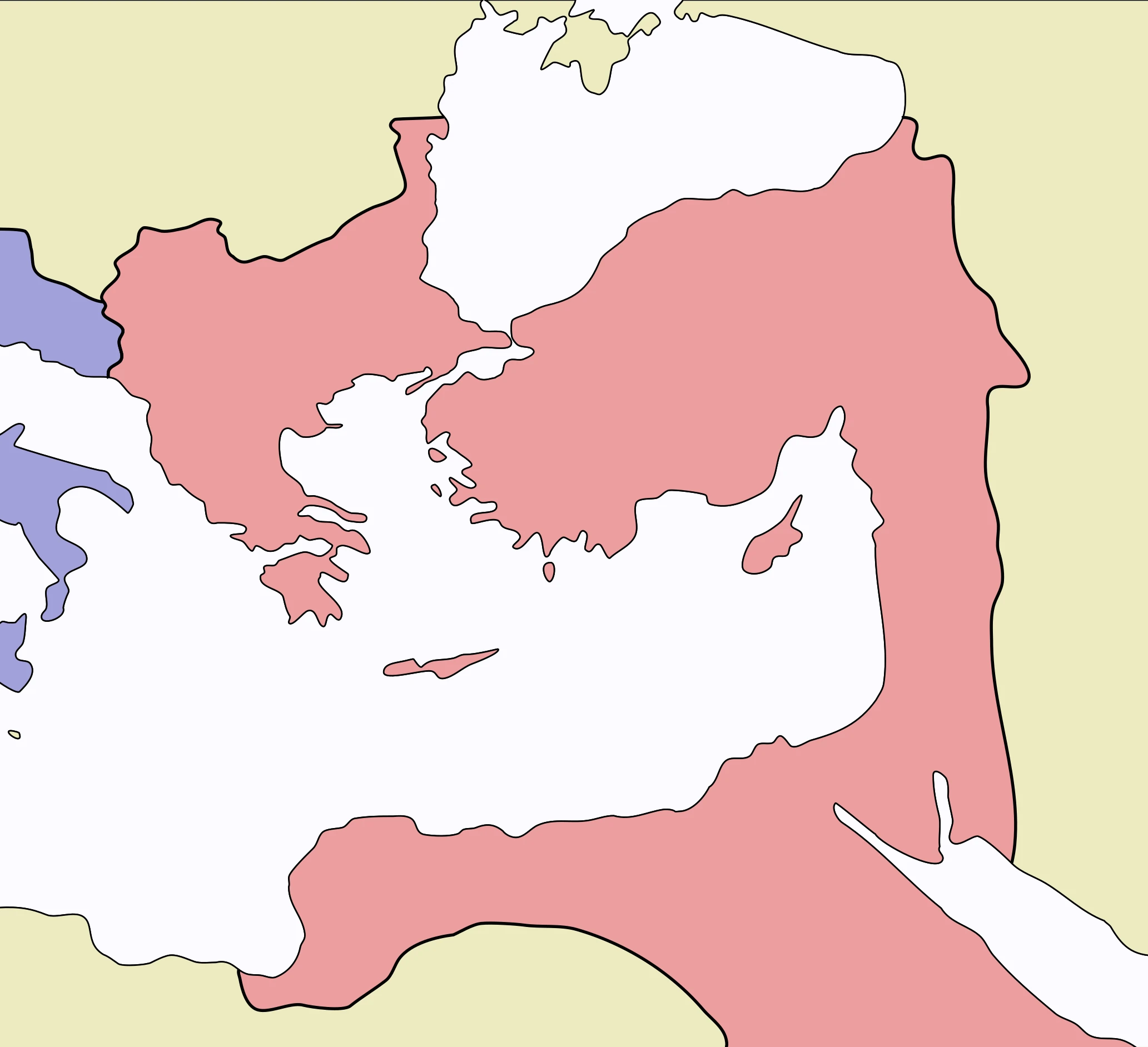
The people of the Eastern Roman Empire did not call themselves Greeks. They called themselves Romaioi, Romans, and meant it. Their emperor ruled from Constantinople, their laws descended from Justinian's codification of Roman jurisprudence, and their political identity was continuous with the empire Augustus had founded. Yet they spoke Greek, thought in Greek, worshipped in Greek, and read Homer and Aristotle in the original. The tension between the Roman name and the Greek substance defined their civilization for its entire existence.
Western Europeans called them Greeks, sometimes with condescension, sometimes with envy. The label was not wrong. The eastern Mediterranean had been Greek-speaking since Alexander's conquests, and when Latin administration faded in the east during the sixth and seventh centuries, the Greek substrate surfaced fully. Constantinople was a Roman capital built on a Greek city, governing Greek-speaking provinces, and staffed by officials who debated theology in the language of Plato.
Constantinople anchored the empire. The city sat on a peninsula controlling the strait between Europe and Asia, protected by massive walls on the landward side and the sea on the other three. At its peak it held perhaps half a million people, making it the largest city in the Christian world. Markets sold silk, spices, grain, and metalwork. The Hippodrome hosted chariot races that doubled as political theatre, with factions of Blues and Greens that functioned as something between sports clubs and street gangs.
Beyond the capital, the empire's heartland was Anatolia and the Aegean coastlands: a landscape of olive groves, terraced vineyards, and wheat fields on the coastal plains, with sheep pasture in the interior highlands. A farmer on the Anatolian plateau in the eighth century lived in a stone or mudbrick house, grew barley and lentils, kept a few goats, and paid taxes in coin to a state that demanded punctuality. Village life revolved around the church, the seasonal calendar, and the local saint's feast day, when icons were carried through the streets and the whole community ate together.
The eastern empire survived where the west collapsed because it had Constantinople's walls, a functioning tax system, and a professional military tradition that adapted constantly. When Arab armies swept through the Levant and North Africa in the seventh century, the empire lost its richest provinces but held Anatolia through a defensive system of regional armies, the themata, that combined military and civilian administration. Soldiers were granted land in exchange for hereditary service, tying defense to the soil.
Greek fire, a combustible liquid sprayed from bronze tubes mounted on warships, gave the Byzantine navy a weapon that no enemy could match or replicate. The formula was a state secret. A sailor manning the siphon on the prow of a dromon off the coast of Constantinople in 678, spraying liquid flame across an Arab fleet, was wielding a technology gap as decisive as any in premodern warfare. The empire's weakness was internal: palace coups, religious controversies, and the constant tension between the capital and provincial military strongmen consumed energy that might have gone toward expansion.
Christianity in the eastern empire was not a private matter but a public argument. Theological disputes over the nature of Christ, the role of icons, and the relationship between divine and human wills consumed generations of emperors, bishops, and ordinary citizens. A shopkeeper in seventh-century Constantinople had opinions about Christology and was willing to fight about them. The Iconoclast controversy, which tore the empire apart for over a century, began as a debate about religious images and became a struggle over the relationship between church and state.
Education remained rooted in the classical tradition. A boy from a prosperous family studied Homer, Euclid, and Aristotle before turning to Christian theology. The connection to ancient Greek learning was not antiquarian but living: physicians read Galen, lawyers studied Roman codes that had been compiled in Greek, and philosophers engaged with Plato as a contemporary voice rather than a historical curiosity. A teacher in ninth-century Constantinople explaining Aristotle's logic to his students stood in an unbroken line of transmission stretching back over a thousand years.
The empire's position at the crossroads of Europe and Asia made Constantinople the richest trading city in the medieval world. Silk, spices, and gems came overland from China and India. Furs and slaves arrived from the north via the rivers of Rus'. Byzantine gold coins, the bezant, circulated as far as Scandinavia and East Africa, trusted everywhere because their weight and purity never varied. The state controlled key industries, especially silk production, and taxed trade at every gate and harbor.
The empire's greatest legacy was preservation. Byzantine scribes copied the manuscripts of ancient Greek literature, philosophy, and science that would otherwise have been lost. When Constantinople fell to the Ottomans in 1453, Greek scholars carried those texts west to Italy, fueling the Renaissance. The classical learning that modern Europe regards as its intellectual foundation survived the medieval centuries largely because Greek-speaking clerks in Constantinople considered it worth recopying, century after century, in a language they had never stopped reading.

 , may spend any number of faith cubes
instead of equal number of
, may spend any number of faith cubes
instead of equal number of 


 total
total

 , you may spend 3
  to pay -1
  from the deck to your hand
In the game, the Greeks out-research everyone. Faith pays for technology, glory discounts products, economy buildings cost less, and you start with two extra cards in hand. The classical inheritance of philosophy and science gives you a head start that only widens as the game progresses. Rush technologies in the early rounds while opponents are still building their economy; the knowledge gap compounds, and by mid-game your tech advantage becomes insurmountable.
Economy buildings are: Market, Forge, Artisan Workshop, and Meadery. Military structures like Barracks or Dockyard do not qualify.
Correct. A building normally costs 5 coins plus 1 wood and 1 stone. The -5 coins discount means one economy building costs only 1 wood and 1 stone. Building multiple economy buildings on the same hex still saves you just 5 coins total, so building them individually maximizes your discount, though you spend more action cubes doing so.
No. The ability says "you may spend 3 glory to pay -1 product" per technology. This can only be used once per technology researched. Maximum discount is 1 product per technology, for 3 glory.
From the current Age deck only. In Age I, this means the Age I technology deck.
Yes. When researching a technology, you may spend faith cubes instead of resources and also spend 3 glory to reduce the product cost by 1. Both abilities apply independently to the same technology.