1-585 CE
The Suebi were a broad grouping of Germanic peoples from the interior of central Europe who migrated west and south in successive waves, with one branch crossing the Pyrenees to establish a kingdom in the remote northwest corner of Iberia that lasted nearly two centuries.
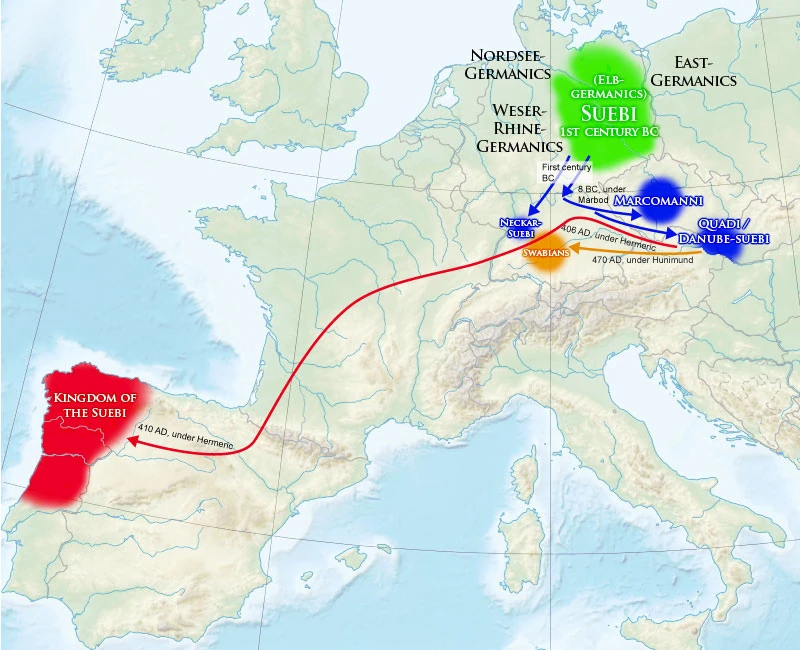
The Suebi were less a single people than a label Roman writers applied to a cluster of Germanic groups from the deep interior of central Europe. Caesar used the name for peoples east of the Rhine; Tacitus described them as the largest and most warlike division of the Germanic world. What linked them was a shared cultural style rather than common political organization: a distinctive knotted hairstyle worn by free men, a reputation for restless mobility, and a habit of moving in large mixed groups of warriors, families, and livestock.
In 406, one branch of this loose grouping crossed the frozen Rhine together with Vandals and Alans, cut through Gaul, and by 409 had pushed into the Iberian peninsula. While the Vandals eventually moved on to North Africa, the Suebi stayed, settling in the northwest corner of Iberia in the old Roman province of Gallaecia.
Gallaecia was a landscape of green river valleys, granite hills, and Atlantic rain. The region had been lightly Romanized compared to southern Iberia: small farms, scattered villages, hill-forts that predated the legions. The Suebi settled among a Celtic-speaking rural population and adopted much of its pattern. Farmsteads worked the valley bottoms, growing rye, millet, and turnips. Chestnut forests on the hillsides provided timber and food in autumn. Cattle grazed the upland pastures in summer and came down to the valleys in winter.
A Suebian farmer in sixth-century Gallaecia lived much as his Gallaecian neighbors did: in a stone-and-thatch house on a hillside, tending a small plot, pressing cider from apples in autumn, salting fish when the sardine runs came inshore. The Germanic newcomers were a military aristocracy layered over an existing population, not a mass replacement. Within a few generations the two groups were difficult to tell apart.
The Suebian kingdom in Gallaecia was small and hemmed in. To the south and east lay Visigothic territory; to the north and west, the Atlantic. The Suebi raided their neighbors when strong enough and retreated into their hills when not. Their infantry moved fast and traveled light, habits carried from the long migration across Europe. A warrior owned his weapons and his legs; heavy cavalry and siege equipment were beyond the kingdom's resources.
The kingdom survived as long as it did partly because Gallaecia was poor enough to be not worth sustained conquest and remote enough to be difficult to hold. The Visigoths absorbed it in 585 without great effort once they turned their full attention to it. By then the Suebian kingdom had existed for nearly 175 years, one of the longer-lived barbarian successor states, though one of the least remembered.
The Suebi arrived in Iberia as pagans. Some adopted Arian Christianity, the variant common among Gothic peoples. The decisive shift came in the mid-sixth century when Martin of Braga, a monk from Pannonia, arrived in Gallaecia and set about converting the Suebian court and countryside to Catholic Christianity. His short treatise De Correctione Rusticorum attacked the lingering folk practices he found among the rural population: offerings at crossroads, divination by birdsong, bonfires on solstice nights.
Martin's complaints are the best window into daily belief. A peasant woman tying a cloth to a tree branch beside a spring, a shepherd reading the weather from the flight of crows, a family leaving bread at a grave on the anniversary of a death: these were the customs Martin wanted eliminated and, by recording them, accidentally preserved. The Suebi converted officially, but the countryside kept its older rhythms underneath the new prayers.
The Suebian kingdom maintained intermittent contact with the wider world. Embassies reached the Frankish courts; trade connections along the Atlantic coast brought goods from Britain and Gaul. The port towns of the Gallaecian coast exported tin, dried fish, and leather. But the kingdom was peripheral to the main currents of post-Roman politics, and its fall to the Visigoths in 585 barely registered in the chronicles of the time.
What survived was subtler. The Suebian presence left traces in place-names, parish boundaries, and possibly in the distinct cultural identity of northwestern Iberia. Galicia and northern Portugal retain characteristics that set them apart from the rest of the peninsula, and some of those differences may trace back to the particular mix of Celtic, Roman, and Germanic that the Suebian period produced. The Suebian knot, that distinctive hairstyle Tacitus described, is long gone. The stubbornness of the landscape and the people in it has proved more durable.

 have +1 movement points


 for each forest hex with your

 , you may spend 2
  to pay -1
  , -1
, -1 
In the game, the Suebi never stop moving. Fast infantry build wherever they stand, forests feed the march, and glory buys cheaper recruits when resources run thin. This mirrors the historical migration from central Europe to Iberia: the Suebi settled on the move and fortified positions as they advanced. Invest in barracks over forges early and use the glory discount to build a large army in Age I before the window closes. Your infantry speed is your strongest asset; a slow Suebi player is a losing one.
Yes. Peasants are classified as infantry, so they benefit from the +1 movement point bonus.
Yes. Construction remains a main action requiring an action cube. The ability only removes the normal requirement for peasants to be present. It does not make construction free or reduce its cost.
No. The ability grants 2 food for each forest hex with your military unit. Peasants are not required. Any military unit on a forest hex qualifies.
No. You must fully pay the 2 glory cost to receive the discount. If you have fewer than 2 glory, you cannot use this ability.
Yes. The ability applies per unit recruited, so you can use it multiple times during a single recruit action. Each unit costs 2 glory for the discount.