200-534 CE
The Vandals were an East Germanic people who migrated from the Baltic to Spain and then to North Africa, where they seized the richest Roman provinces, built a pirate fleet, and sacked Rome itself in 455 with a thoroughness that gave their name to mindless destruction.
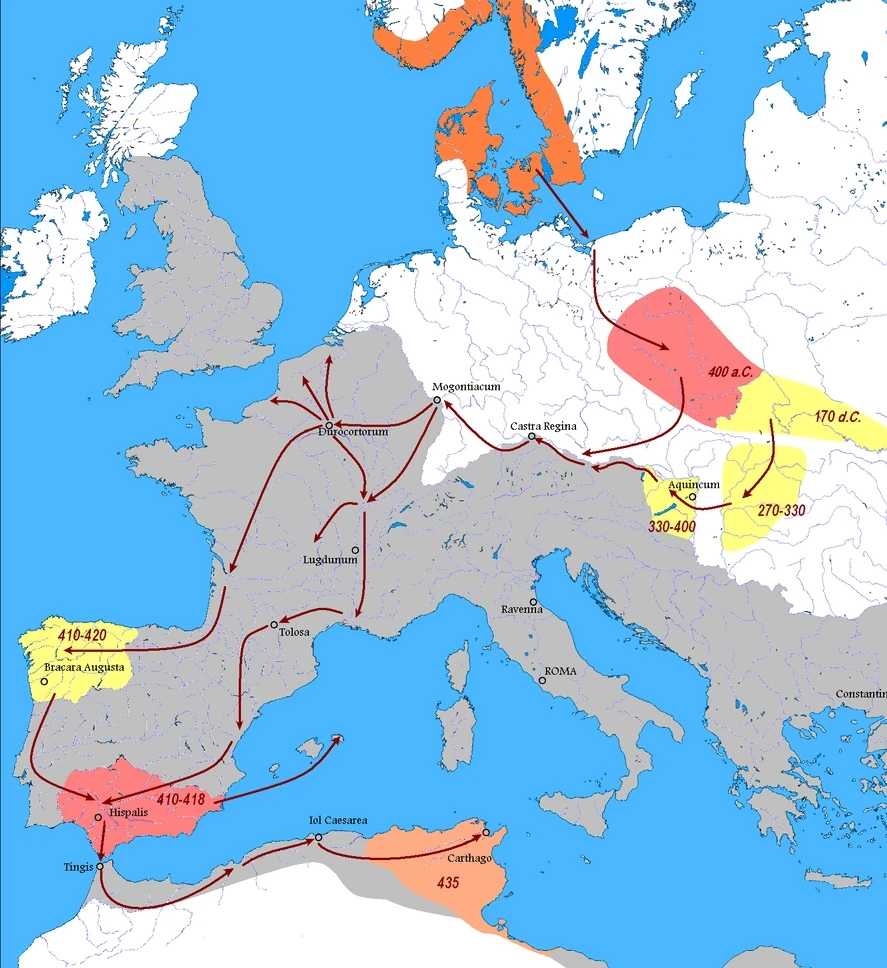
The Vandals were an East Germanic people who originated somewhere near the Baltic coast and spent centuries drifting south and west before making the most audacious move of the Migration Period: crossing the Strait of Gibraltar and conquering Roman North Africa. Their name became a byword for wanton destruction, though the historical Vandals were no more destructive than their contemporaries. They were, however, exceptionally good at taking what they wanted and holding it against all comers.
They traveled in the company of Alans, a steppe people absorbed along the way, and arrived in Africa as a mixed confederation rather than a pure ethnic group. What held them together was military discipline, Arian Christianity, and a leadership that understood sea power before most Germanic peoples had figured out sails.
The Vandals had no single homeland. They passed through Pannonia, crossed the frozen Rhine in the winter of 406, spent two decades in Spain, and finally crossed to Africa in 429. Each territory was a staging ground, not a destination. Their true home, for the century that mattered, was the old Roman province of Africa Proconsularis: the wheat fields, olive groves, and port cities of modern Tunisia and eastern Algeria.
North Africa in the fifth century was still one of the wealthiest regions in the western Mediterranean. The grain estates that had fed Rome for centuries now fed the Vandal elite. A Vandal warrior-landlord outside Carthage inherited irrigated fields, slave labor, a stone villa with mosaic floors, and a climate that produced two harvests a year. His children grew up speaking Latin, eating figs and olives, and bathing in Roman bathhouses. The conquerors adapted to provincial Roman life faster than almost any other Germanic people, keeping only their Arian faith and their military structure as markers of separateness.
The Vandals' great innovation was naval. Genseric, who led the crossing to Africa and ruled for nearly fifty years, built a fleet from captured Roman shipyards and turned the western Mediterranean into a Vandal lake. His ships raided Sicily, Sardinia, Corsica, and the coast of Italy at will. The sack of Rome in 455 was a naval expedition: the fleet sailed up the Tiber and the army spent two weeks methodically stripping the city of portable wealth, including, according to tradition, the treasures of the Temple of Jerusalem that Titus had brought to Rome four centuries earlier.
On land the Vandals were competent but not exceptional. Their army was small and relied on the same mounted warrior aristocracy common to all Germanic kingdoms. What made them difficult to dislodge was the sea. Two major Roman expeditions against Vandal Africa failed, partly through Vandal naval superiority and partly through Roman incompetence. When Belisarius finally conquered the kingdom in 533-534, he did it with a small professional army that caught the Vandals off guard. The kingdom collapsed in a single campaign, and the Vandals vanished from history almost overnight.
The Vandals were committed Arians, and unlike the Visigoths or Longobards, they actively persecuted the Catholic population. Catholic bishops were exiled, churches were confiscated and handed to Arian clergy, and Catholic worship was periodically banned. This made the Vandal kingdom uniquely unpopular with its own subjects and ensured that when Belisarius arrived, the local population welcomed him as a liberator.
Vandal society in Africa split into two layers that barely touched. The warrior elite lived on confiscated estates, hunted, held banquets, and maintained their Germanic customs in dress and grooming. A Roman poet who visited Vandal Carthage described noblemen reclining on couches with oiled hair, eating from silver plates while musicians played. Below them, the Roman provincial population continued farming, trading, and worshipping in Catholic churches when they were allowed to. A potter in a Carthaginian workshop firing red-slip tableware in the 490s worked with the same techniques his grandfather had used; only the tax collector had changed.
The Vandal kingdom controlled the grain supply of the western Mediterranean for a century. Sardinia, Corsica, and the Balearic Islands served as naval bases. Trade continued through Carthage's harbors, though increasingly on Vandal terms. The kingdom maintained diplomatic contacts with other barbarian courts and with Constantinople, alternating between negotiation and raiding depending on the political weather.
The speed of the kingdom's disappearance after 534 is remarkable. Within a generation of Belisarius's conquest, the Vandals had dissolved into the African population, leaving almost no archaeological or linguistic trace. No Vandal words entered the local Romance or Berber languages. No distinctive Vandal art style survived. What survived was the reputation: the word "vandalism," coined in the eighteenth century, preserving in garbled form the memory of a people who had been gone for over a thousand years.

 have +1 strength bonus vs

 , gain 1 Building


 that was engaged in this battle on your or the enemy's side to gain 20

 , you may spend 1 action cube to gain 1 exhausted
In the game, the Vandals treat destruction as economic policy. Structures crumble faster under your melee attacks, and the rubble becomes your own buildings. Nothing was sacred to the Vandals, and a holy relic is worth exactly 20 coins if you are willing to melt it down. Victories spawn vessels. Target opponents who have invested heavily in structures and fortifications; you convert their investment into your own infrastructure faster than they can rebuild.
You may place the building on any hex where you have a peasant, where you don't already have a city or castle, and where there are fewer than 3 buildings. Standard building placement rules apply. Sea and swamp hexes are not eligible.
Yes. The ability says "a relic that was engaged in this battle on your or the enemy's side." You may remove your own relic or the enemy's relic, as long as it was engaged in the battle you won.
It is permanently removed from the game and cannot reappear. This also reduces the total number of relics that can appear in unexplored provinces. The game normally generates relics equal to the number of players minus 1. Each removed relic reduces future appearances by 1.
Place the vessel on a sea or ocean hex adjacent to one of your cities.
No. The action cube returns to your supply during the Cleanup phase at the end of the current round, just like any other spent action cube.