100-965 CE
The Alans were an Iranian-speaking nomadic people of the Pontic steppe whose mounted warriors scattered across the ancient world, riding with the Vandals into Africa, with the Goths into Gaul, and possibly with the Sarmatians to Britain, leaving traces on three continents.
The Alans were an Iranian-speaking pastoral people of the western Eurasian steppe, closely related to the Sarmatians and ultimately descended from the same Scythian-world nomadic cultures that had dominated the grasslands north of the Black Sea for centuries. Greek and Roman writers grouped them with the broader Sarmatian family but recognized them as distinct: taller in their own estimation, lighter-haired than their neighbors, and devoted to horses and warfare beyond even the usual steppe standard.
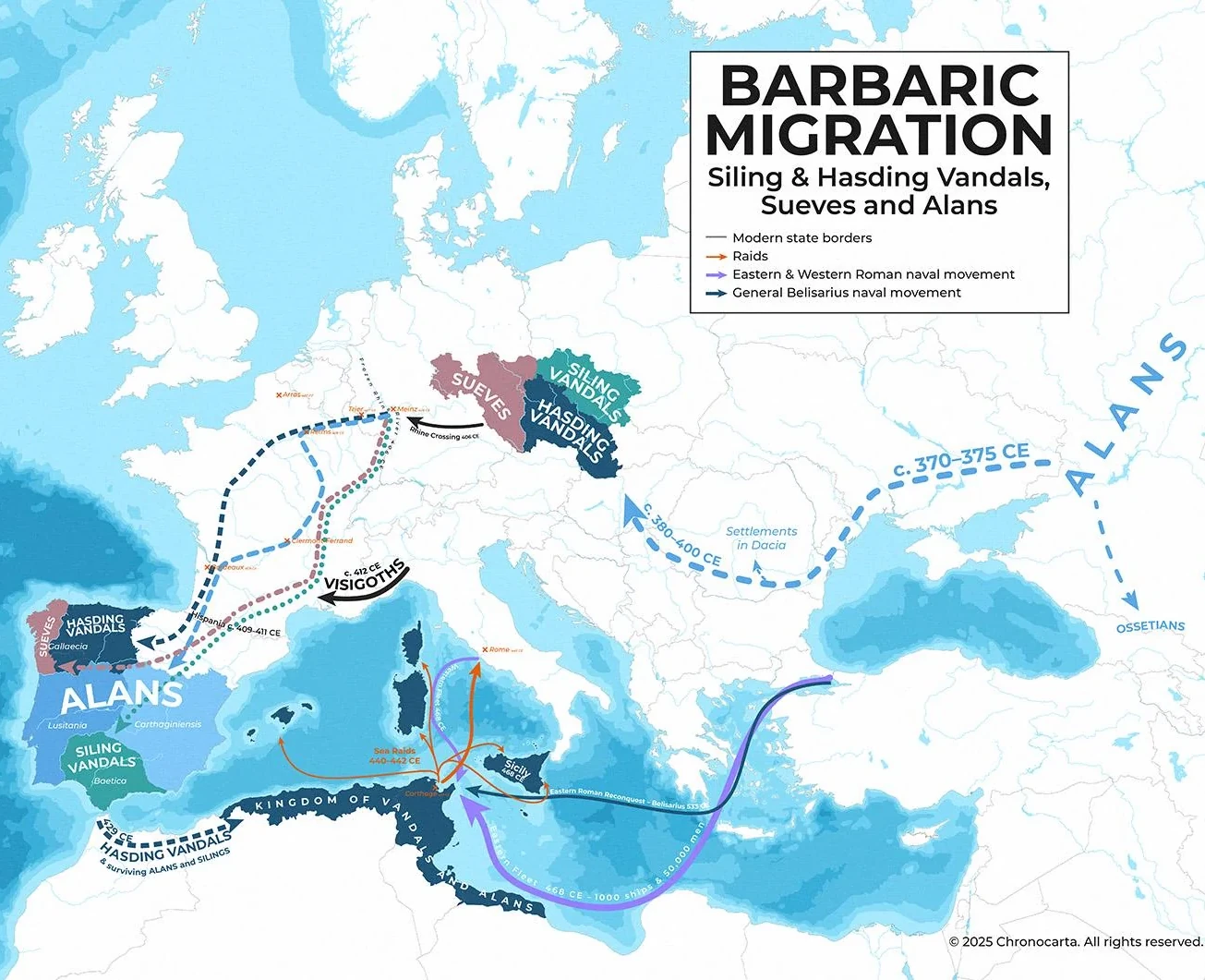
What makes the Alans remarkable is not what they built but where they ended up. No other people of the Migration Period dispersed so widely. Fragments of the Alan nation appear in the historical record from the Caucasus to Carthage, from the Loire valley to the hills of Wales, carried across the ancient world by the currents of imperial collapse.
The Alan heartland was the open steppe north of the Caucasus and along the Don and Kuban rivers: flat grassland stretching to the horizon, broken by river valleys where winter camps could shelter from the wind. Life followed the herds. Horses, cattle, and sheep moved between summer and winter pastures, and the people moved with them. A family's wealth was counted in horses. A man who could not ride was not fully a man.
The camp was home: felt-covered wagons arranged in a circle, the smell of fermented mare's milk, dogs guarding the livestock perimeter at night. Women managed the household economy, processed hides and wool, and rode as competently as men. Children learned to sit a horse before they could run steadily on their own feet. The steppe provided little besides grass and sky, but for a people whose technology was the horse and whose infrastructure was portable, that was enough. A herdsman watching his horses graze on a spring evening along the Don needed nothing from the settled world except metal for weapons and harness fittings.
Alan cavalry was heavy by steppe standards. Unlike the Huns, who relied primarily on mounted archery, the Alans combined archery with shock tactics: armored lancers on big horses who could close with an enemy line and break it. Their horses wore leather or scale armor. Their riders carried the long contus lance, gripped with both hands, that could unseat a Roman cavalryman at full gallop. The combination of ranged harassment and armored charge made Alan cavalry valuable to every power that encountered them, and the Alans hired out readily.
This versatility was both strength and weakness. The Alans never unified into a centralized state. Clan chiefs led their own followings and allied with whoever offered the best terms. When the Huns swept across the steppe in the late fourth century, some Alan groups submitted and rode with the Hunnic armies. Others fled west and attached themselves to the Vandals and Suevi crossing the Rhine in 406. Still others retreated into the Caucasus mountains, where their descendants, the Ossetians, live today.
Alan religion followed patterns common across the Iranian-speaking steppe world. A naked sword planted in the ground served as an object of veneration, perhaps representing a war god. Offerings were made to fire, to water, and to the open sky. The dead were buried in kurgan mounds with their weapons, their horses, and sometimes gold ornaments of remarkable craftsmanship. Sarmatian and Alan metalwork, with its animal-style motifs of griffins, deer, and coiling predators, ranks among the finest decorative art of the ancient steppe.
Society was organized by clan and headed by warrior aristocrats whose authority rested on military success and the ability to distribute plunder. A chief who stopped winning lost his followers to someone who had not. Hospitality was sacred: a guest in an Alan camp was inviolable, and refusing hospitality was a serious insult. Marriage alliances bound clans together across the steppe, and bride-prices were paid in horses. A widow could inherit her husband's herds and status, and some women were buried with weapons, suggesting that the boundary between male and female roles was more flexible than in the settled societies to the south.
The Alan diaspora touched every corner of the late antique world. One group crossed into Gaul with the Vandals and settled around Orléans, where Alan cavalry served as foederati and Alan place-names survive in the countryside. Another contingent continued with the Vandals into Spain and across the strait to North Africa. A smaller branch may have accompanied Sarmatian auxiliaries to Roman Britain, and some scholars have traced elements of the Arthurian legend to Alan cavalry traditions carried to the island. The theory remains disputed, but the geographical reach it implies is not: Alans genuinely did serve in Roman armies posted to Britain.
In the Caucasus the Alans established a kingdom, Alania, that endured into the thirteenth century and converted to Christianity under Byzantine influence. The Ossetians of modern Georgia and southern Russia preserve an Iranian language descended from Alan speech, and their Nart sagas contain narrative elements that scholars have linked to both Alan steppe traditions and the wider Indo-European mythological heritage. A people who left no written records and built no permanent cities nevertheless left genetic, linguistic, and cultural traces from the Caucasus to the Atlantic.

 with
with  has +1 strength
on the meadow
has +1 strength
on the meadow


 of your
  ,
gain 1 available
,
gain 1 available


 to unexplored
  to explore them
In the game, the Alans charge hardest on flat meadow, where their armored lancers hit with full steppe-cavalry force. Every defensive battle swaps a white cube for your own color, turning retreat into counterattack. Peasants scout unexplored provinces, so you can explore and build a city in the very first round. Invest in research to generate free cavalry. Since your peasants deal damage when defending, the Alans work equally well as an early rusher or an economic power, flexible enough to read the table and adapt.
No. After bag preparation, you simply take any 1 white cube from the bag and replace it with 1 cube of your color. No random drawing is involved.
Yes. The ability triggers when defending, regardless of which unit types are involved. Peasants defending alone still benefit.
2 movement points. Since peasants cannot march and have only 2 movement points, they can only explore provinces directly adjacent to their starting hex. Position them next to the unexplored province before moving.
No. You gain 1 "available" cavalry, which requires the supporting structure. Without Barracks, cavalry is not available to you. Building Barracks later does not grant retroactive cavalry for previously researched technologies.
Yes. The bonus applies whenever your army with cavalry is on a meadow hex, regardless of whether you are the attacker or defender.