1-600 CE
The Celts who survived into the post-Roman centuries clung to the western and northern fringes of Europe, holding forested hills, Atlantic coastlines, and rain-soaked islands where neither Rome nor the Germanic successor kingdoms could fully reach them.
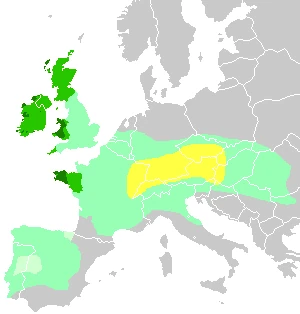
By the first century CE the Celts were no longer the dominant people of Europe. The great Celtic world that had once stretched from Anatolia to Ireland had been shattered by Roman conquest, Germanic pressure, and centuries of assimilation. What remained were fragments: the Britons of the island that bore their name, the Irish across the western sea, the peoples of Caledonia beyond Hadrian's Wall, and scattered communities in Brittany, Wales, and Cornwall. These were not a unified nation but peoples who spoke related languages, shared certain cultural habits, and occupied the terrain that nobody else wanted badly enough to take from them.
The Celts of this period were survivors. They lived where the forests were thickest, the coastline roughest, and the soil least rewarding to a conqueror.
In post-Roman Britain the old tribal territories reasserted themselves within a generation of the legions' departure around 410. The lowland south and east, with its open farmland and Roman roads, was vulnerable to Saxon settlement. The highland west and north held: Wales, Cornwall, Cumbria, the hills of what is now Scotland. These were landscapes of oak and ash forest, upland pasture, and narrow river valleys where a few cattle and a patch of oats could sustain a family.
A British farmstead in fifth-century Wales was a round or rectangular timber house with a thatched roof, a central hearth, and a yard for livestock. Cattle were the primary measure of wealth. A man's standing depended on how many head he owned, and cattle-raiding between neighboring chieftains was sport, economics, and warfare rolled into one. Cheese and butter kept through winter; barley bread and porridge filled the rest of the diet. Iron tools were locally made and carefully maintained. A smith who could forge a good plowshare was as valued as one who could hammer out a sword.
The departure of Roman authority left the Britons organized but exposed. Romano-British leaders, sometimes called tyrants in the Latin sources, maintained a thin layer of Roman civic structure while fighting a losing war against Saxon, Angle, and Jute settlers pushing inland from the east coast. The battles were small, local, and constant. A warband of a few dozen mounted men defending a river crossing or ambushing a Saxon column in a forest track was the typical engagement.
Somewhere in this chaos the legend of Arthur took root. Whether he was a real war-leader, a composite of several, or pure invention remains unclear, but the tradition preserves a genuine historical memory: that for a period in the late fifth or early sixth century, British resistance stiffened and Saxon expansion stalled. The victory at Badon Hill, wherever it was, became the fixed point around which later storytellers built a king, a court, and a round table. The real defenders of post-Roman Britain were nameless men fighting in forests they knew and their enemies did not.
The Britons had been Christian since the late Roman period, and Christianity survived the collapse of Roman administration without interruption. Celtic Christianity developed its own character in isolation from Rome: different methods of calculating Easter, distinctive tonsures, and a monastic structure that made abbots more powerful than bishops. Monasteries like Bangor, Llantwit Major, and later Iona became centers of learning, manuscript production, and missionary activity.
In Ireland, which Rome had never touched, a parallel Celtic world flourished. Irish society was organized around kin-groups and cattle wealth, governed by an elaborate legal system, the Brehon laws, that regulated everything from marriage to the compensation owed for a satirist's insult. Irish monks carried Celtic Christianity back to the continent in the sixth and seventh centuries, founding monasteries in Gaul and beyond. A monk from Clonmacnoise copying a psalm onto calfskin vellum by candlelight was part of a tradition that would help preserve Latin learning through the darkest centuries of the early medieval west.
The Celtic world of this period was connected by the sea. Trade and migration moved along Atlantic routes linking Brittany, Cornwall, Wales, Ireland, and western Scotland. Tin from Cornwall, leather from Ireland, and pottery from the Mediterranean passed through ports that had functioned since before Roman times. The sea was easier than the land: a currach from Ireland could reach the west coast of Scotland faster than a man on horseback could cross Wales.
The Celtic languages retreated with their speakers. Brythonic survived as Welsh, Cornish, and Breton; Goidelic became Irish, Scots Gaelic, and Manx. The peoples themselves did not vanish so much as compress into the margins of the map, carrying with them a literary and artistic tradition, the intricate knotwork and spirals of insular art, the poetry of the Welsh bards, the legal sophistication of the Irish jurists, that would outlast every kingdom that had pushed them aside.

 has +1 strength in the forest


 in the forest ignores 1 damage dealt by
an enemy with
in the forest ignores 1 damage dealt by
an enemy with 


In the game, the Celts own the forest. Two stacking bonuses make your armies devastating among the trees: extra strength and damage reduction from melee attacks combined. Faith cubes spent before combat replace enemy cubes with your own in the bag, a druidic fury that tilts every battle. Win, and you earn mead. Press early aggression before more economically focused nations outscale you. Your combat abilities peak relative to opponents in the first age, so use that window to take territory and stockpile mead from victories.
Only if they are part of an army, meaning they share a hex with at least one military unit. Peasants alone on a forest hex do not benefit from this ability.
Yes. The ability says you "gain" mead, not "produce" it. You receive the mead directly as a reward for victory, regardless of whether you have any buildings that produce mead.
After bag preparation but before the battle drawing begins. You spend faith cubes, draw that many cubes from the prepared bag, replace each drawn cube with a cube of your color, then return them all to the bag. This improves your odds before the actual battle draws occur.
Yes. Both abilities apply simultaneously when your army is in a forest hex. Your army deals more damage and absorbs more punishment at the same time.
Yes. The ability triggers as long as the enemy army has melee units. If it does, your army in the forest ignores 1 damage dealt by that army, regardless of whether the damage came from melee or ranged sources.