260-843 CE
The Franks were a confederation of Germanic warrior bands who crossed the Rhine into Roman Gaul and built, over six centuries, the largest kingdom in western Europe, binding conquered provinces together through baptismal water, monastic land grants, and the iron habit of dividing everything among their sons.
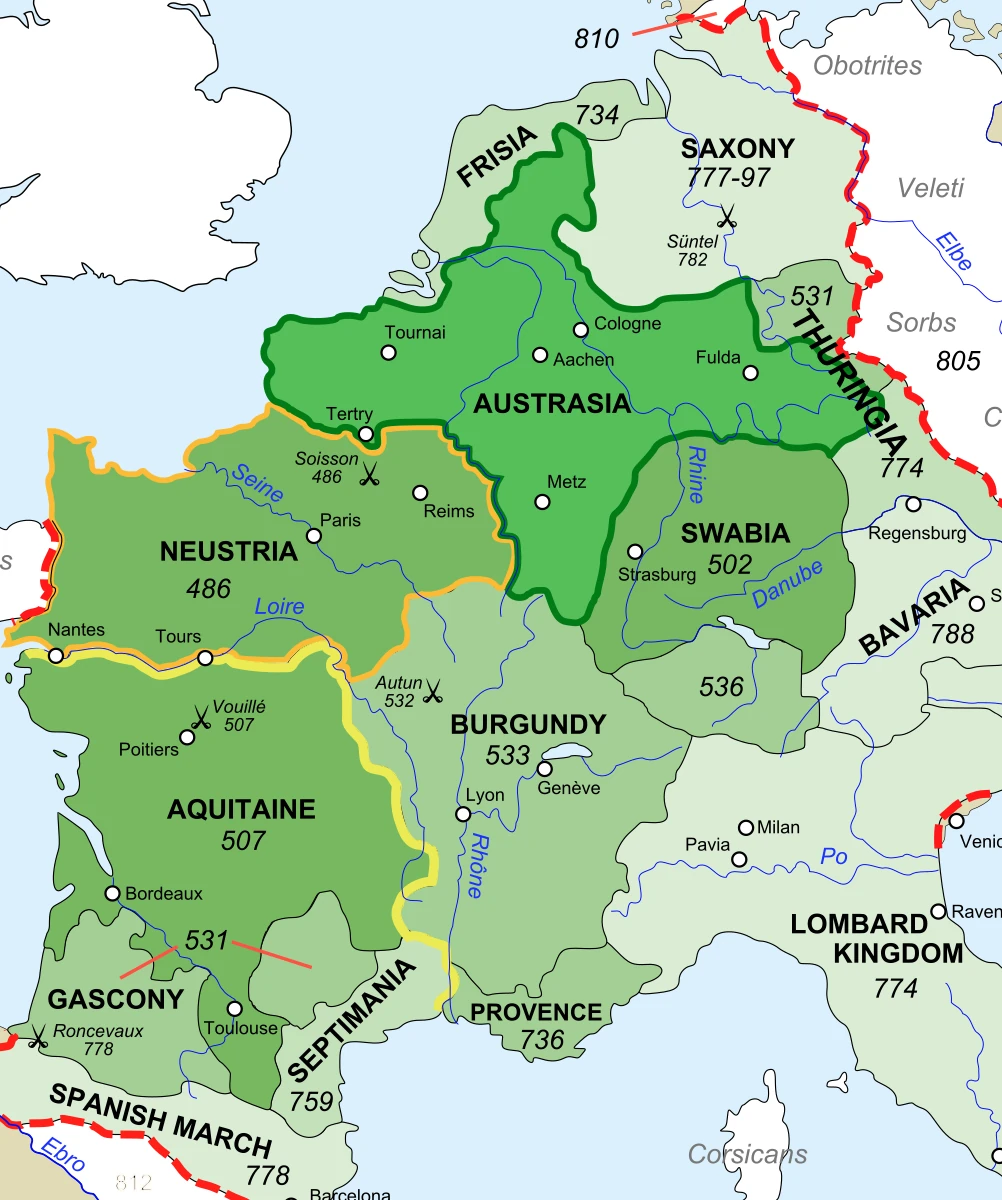
The Franks were not a single tribe but a loose coalition of Germanic-speaking groups who lived along the lower Rhine in the third century and gradually pushed south and west into what had been the most thoroughly Romanized territory in northern Europe. The name itself may come from a word for "bold" or "fierce," though this is uncertain. What is certain is that by the late fifth century these scattered war-bands had merged into a kingdom that swallowed Gaul whole and gave its name, eventually, to France.
Their story is not one of replacement but of dissolution. The Franks who settled in Gaul dropped their Germanic tongue within a few generations, adopted late Roman administrative habits, and converted to Catholic Christianity so early and so completely that later centuries forgot they had ever been pagan at all.
The earliest Frankish homelands lay in the marshy lowlands between the Rhine and the Meuse: heavy clay soils, oak forest, river fog. As they expanded into Gaul they inherited a countryside of old Roman estates, many still functioning, their fields worked by tenant farmers who scarcely noticed the change of masters. A Frankish lord who took over a villa near Tours or Soissons stepped into a going concern: vineyards, grain fields, workshops, a chapel. He kept the bailiff, kept the tenants, and hung his sword on the wall of the stone dining hall.
Most Franks were not lords. A peasant family in northern Gaul lived in a sunken-floored hut, its lower half dug into the earth, roofed with thatch, heated by a single hearth. Cattle, pigs, and people shared close quarters. Spring meant plowing with heavy iron-shod plows suited to the wet northern soils; autumn meant slaughtering animals that could not be fed through the dark months. Honey was collected from forest hives and fermented into mead. In the south, where Roman viticulture survived, wine remained the daily drink of anyone who could afford it.
Frankish kings led from the front. The francisca, a short throwing axe that may have given the Franks their name (or taken it from them), was one signature weapon. The scramasax, a heavy single-edged knife, was another. But the real Frankish military advantage was organizational: Clovis, who united the Salian and Ripuarian Franks and conquered most of Gaul by the time of his death in 511, combined Germanic war-band loyalty with Roman-style command. He paid soldiers, garrisoned cities, and used bishops as provincial administrators.
The weakness was succession. Frankish custom divided a dead king's realm among all his sons, and every generation produced civil wars as brothers fought for larger shares. A kingdom assembled by one generation fractured in the next. The Treaty of Verdun in 843 split the Carolingian Empire into three parts, and the Frankish world never reunited.
Clovis's baptism, probably in the late 490s at Reims, made the Franks the first major Germanic people to adopt Catholic Christianity rather than the Arian variant favored by the Goths and Vandals. Catholic bishops in Gaul suddenly had a king who shared their creed and needed their literacy. The alliance between Frankish crown and Catholic church became the defining feature of the kingdom. Monasteries multiplied across Frankish territory: Irish monks founded houses at Luxeuil and elsewhere, Benedictine foundations followed. These were working institutions as much as spiritual ones, each a landlord, a school, a scriptorium, and a granary rolled together.
The Lex Salica, compiled under Clovis, recorded Frankish custom in written Latin and covered everything from the fine for stealing a pig to the blood-price for killing a free man. It famously excluded women from inheriting land, a provision that would echo through French legal history for centuries. Gregory of Tours, the Gallo-Roman bishop who wrote the most vivid account of Merovingian life in his Histories, painted a world of feuding kings, scheming queens, miraculous saints, and ordinary people trying to stay out of the way.
At its greatest extent under Charlemagne, the Frankish realm stretched from the Pyrenees to the Elbe, from the North Sea to central Italy. Charlemagne forced the Saxons to accept baptism at sword-point, exchanged embassies with the Abbasid caliph in Baghdad, and imposed Carolingian minuscule, the script that became the ancestor of the lowercase letters on this page. His court at Aachen gathered scholars from Ireland, Italy, and Spain and produced the closest thing to a cultural revival that western Europe had seen since Rome.
But the empire was Frankish, and Frankish habits killed it. Charlemagne's grandsons divided it at Verdun in 843. The western portion became the ancestor of France, the eastern of Germany. The Frankish people as such disappeared into these successor states, but their legacy was the political and religious framework of medieval western Europe: a Latin-speaking church allied with Germanic-descended kings governing territories that still, roughly, define the map of modern nations.


 adjacent to your engaged
  . Discard any number of drawn cubes, and return the rest to the bag

 for each area of your player mat with
at least 2 action cubes
for each area of your player mat with
at least 2 action cubes
In the game, the Franks reward patience and concentration. Religious communities make nearby armies dangerous, coastal Meaderies fund expansion, and the deep faith cube reserve means you can time your religious push for maximum impact. The achievement phase pays you for committing at least 2 cubes per area, so avoid spreading action cubes thin across many areas. Build up your religious network first, then let it subsidize everything else.
Your normal faith cube storage limit is increased by 4. This means you can accumulate more faith cubes before being forced to spend them. It does not give you 4 free cubes; you still need to acquire them through normal means. The higher cap lets you build up reserves for a large conversion push or save cubes across rounds.
No. Each of your cities adjacent to a sea hex automatically has a Meadery without you placing any building token. This means each such city lets you produce one additional mead when you produce it, and also collects 1 extra coin in taxes. If you build multiple cities along the coast, each one with sea adjacency gains its own Meadery. You do not need to spend an action or resources to build these Meaderies.
No. The ability specifies religious communities adjacent to your engaged army. A community in the same province as your army is not adjacent to it. Only communities in neighboring provinces count toward the number of cubes you draw.
Yes. After drawing, you may discard any number of the drawn cubes, including all of them. Cubes you choose not to discard are returned to the bag. This lets you remove unfavorable cubes (such as your opponent's colors) from the bag before the battle draw begins, effectively filtering the bag in your favor.
Yes, and in a way that partially offsets corruption's cost. When you have corruption (an adversity) in an area of your player mat, you must place 2 action cubes to activate that area. This means any corrupted area you choose to activate will automatically meet the threshold of "at least 2 action cubes," qualifying for the +1 product bonus during the achievement phase. Corruption still costs you an extra cube to use the area, but as the Franks, that penalty automatically triggers your bonus. Other nations get no such compensation.
No. Only cubes sitting in the areas of your personal player mat qualify.