200-774 CE
The Longobards were an East Germanic people who wandered from the lower Elbe through Pannonia and into Italy, where they conquered most of the peninsula and ruled a fractious kingdom for two centuries until Charlemagne's Franks ended it.
The Longobards, later called Lombards, were a Germanic people whose own origin story placed them on the southern shore of Scandinavia before a long migration carried them to the lower Elbe, then southeast through what is now Austria and Hungary, and finally into Italy in 568. The name traditionally meant "long beards," and Paul the Deacon, their eighth-century historian, recorded the legend with evident pride: the god Wodan, tricked by their women into looking at them at dawn, saw their long hair arranged to resemble beards and gave them a name and a victory in the same breath.
They were never numerous. The invasion of Italy was carried out by a mixed host of Longobards, Saxons, Gepids, and others, perhaps 100,000 people in total including families. What they lacked in numbers they made up for in timing: Italy had just been devastated by decades of war between Byzantines and Ostrogoths, and the peninsula's defenses were exhausted.
Before Italy, the Longobards spent over a century in Pannonia, the flat grasslands of the middle Danube. They herded cattle, farmed grain where the soil allowed it, and absorbed customs from the Avars, Gepids, and remnant Roman populations around them. They arrived in Italy as a people already shaped by multiple landscapes, adaptable rather than fixed in their habits.
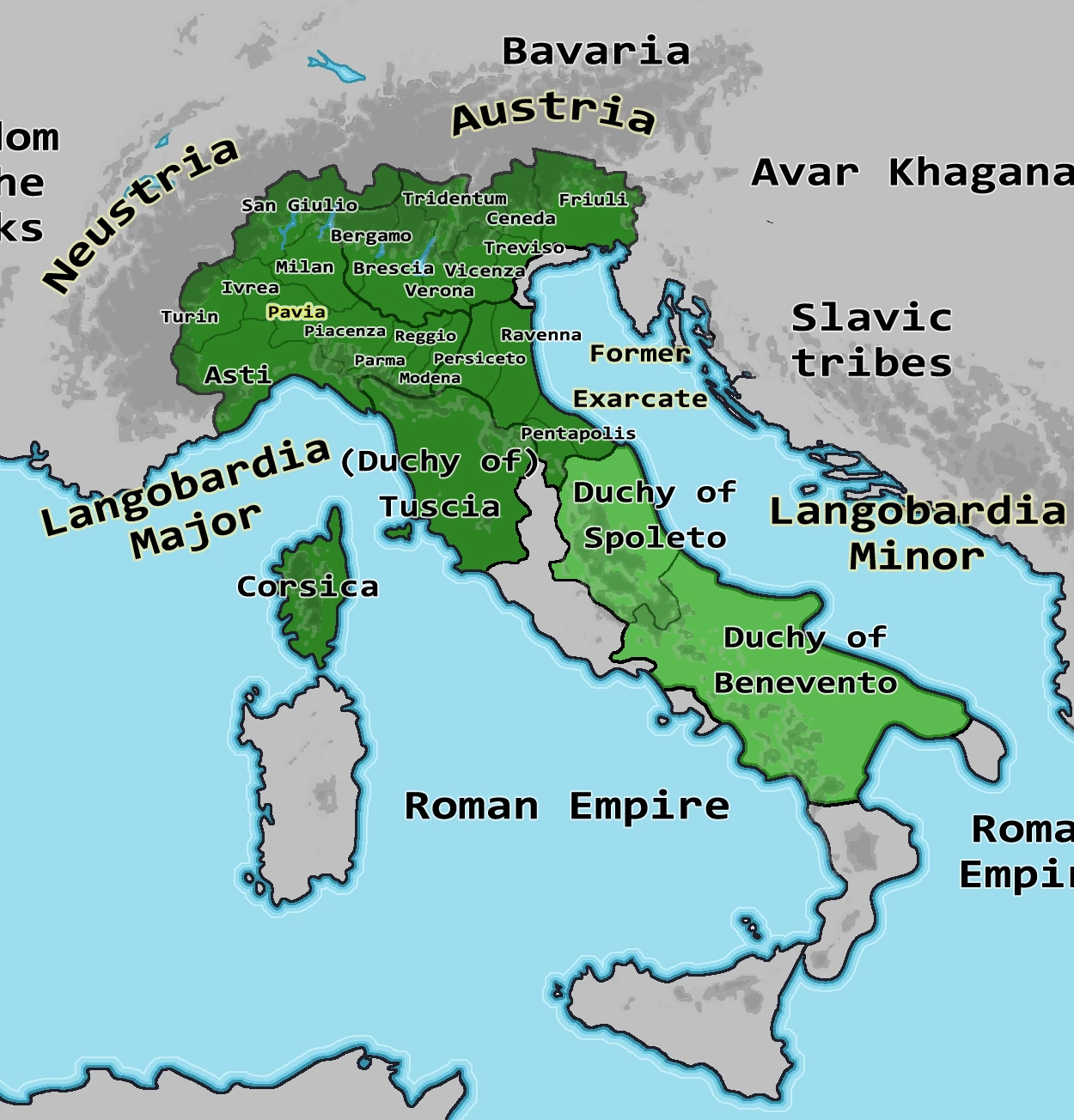
In Italy they settled primarily in the Po valley and the inland hills. The conquerors distributed themselves across the countryside in small groups, occupying existing estates and towns. A Longobard warrior-landlord in seventh-century Brescia or Spoleto lived among Italian tenants, collected rents in grain and wine, and wore a mix of Germanic and Mediterranean clothing. His wife kept the household keys, oversaw the kitchen garden, and spun wool on a drop spindle no different from the ones Italian women had used for centuries. Pavia became the capital, a modest city by Roman standards but sufficient for a court that governed through dukes rather than centralized bureaucracy.
The Longobard kingdom was a loose structure. Powerful dukes in Spoleto, Benevento, and Friuli ran their territories with near-independence, and the king in Pavia spent as much energy managing his own nobles as fighting external enemies. The military was built around a free warrior class who owed service in exchange for land. A man's worth was measured by his arms: sword, shield, and the heavy lance that gave Longobard cavalry its reputation.
The kingdom never controlled all of Italy. Rome, Ravenna, Naples, and much of the south remained Byzantine. This patchwork geography made the Longobards permanent neighbors of an empire that wanted them gone and a papacy that feared them. When Longobard kings pressed too hard on Rome, the popes called in the Franks. Charlemagne crossed the Alps in 773, besieged Pavia, and took the Longobard crown for himself. The duchy of Benevento in the south held out longer, but the kingdom as a unified state was finished.
The Longobards were among the earliest Germanic peoples to adopt Arian Christianity, and they held to it stubbornly even after settling among a Catholic Italian population. The religious divide reinforced social separation: Longobard and Roman lived side by side but worshipped in different churches and married within their own communities. Conversion to Catholicism came gradually through the seventh century, driven by queens and churchmen rather than royal decree. Queen Theodelinda, a Catholic Bavarian princess married to a Longobard king, built churches and promoted the new faith with a patience that eventually shifted the court.
Longobard law was codified in the Edictum Rothari of 643, one of the most detailed Germanic legal codes. It listed fines for every conceivable injury: a knocked-out tooth, a severed finger, an insult to a free woman. A man who killed another man's trained hawk owed compensation calibrated to the bird's hunting value. The code reveals a society obsessed with precise gradations of status, where a free man, a half-free man, and a slave occupied distinct legal universes, and where disputes were settled by payment rather than feud whenever possible.
The Longobards gave their name to Lombardy, and their influence on Italian culture ran deeper than the name. Italian legal traditions, land-holding patterns in the north, and dozens of place-names carry Longobard traces. Words like "balcone" and "guardia" entered Italian from Longobard Germanic. Their metalwork, especially the gold crosses sewn onto burial shrouds and the elaborate belt fittings found in warrior graves, represents some of the finest Germanic decorative art.
Paul the Deacon, a monk at Monte Cassino writing in the late eighth century, composed the Historia Langobardorum, a history of his people that remained the standard account for centuries. He wrote as a man of two worlds: a Longobard by blood, a Latin Christian by education, and a subject of Charlemagne by political reality. His book is part tribal memory and part elegy for a kingdom that had already ended. The Longobards disappeared as a distinct people within a few generations of the Frankish conquest, absorbed into the Italian population they had once ruled. What remained was the landscape they had reshaped and the laws they had written down.

 ,
you may spend 1
,
you may spend 1  instead of 1


 in the newly created

 to explore them

In the game, the Longobards explore with prayer. Religion spreads into unexplored provinces to reveal them, and new communities sprout peasants who settle the land behind the missionaries. Cloth arms your soldiers when weapons are scarce. Christianity arrives as a free action before turn one. Build meaderies early and spread religion even before choosing a government; your faith cubes become your peasant supply. To keep faith cubes flowing, vote for events that inflict adversities, since Christians gain faith cubes by overcoming them. Cities can wait; your missionaries do the settling for you.
The same way you spread into an explored province without enemy control. You can use the Quick Spread rule by paying 1 mead, and the spread is automatically successful. The province is then explored as part of the same action.
On any hex of that province that is free from foreign objects. The peasant goes into the province where the new religious community was created, not to your capital or starting province.
Yes. The ability says "when recruiting any number of military units." You may substitute 1 cloth for 1 weapon for each unit you recruit in that action.
No. During your first Reform action you may only choose a government form. You already have a religion, Christianity, which you chose as a free action, so there is no religion to choose during that first Reform.
No. Free actions do not require action cubes. You choose Christianity at the start of your first turn without spending any resources.