750-1000 CE
The Oghuz were a Turkic tribal confederation of the Central Asian steppe who migrated westward in successive waves, producing some of the medieval world's most formidable cavalry armies and eventually giving rise to the Seljuk and Ottoman dynasties.
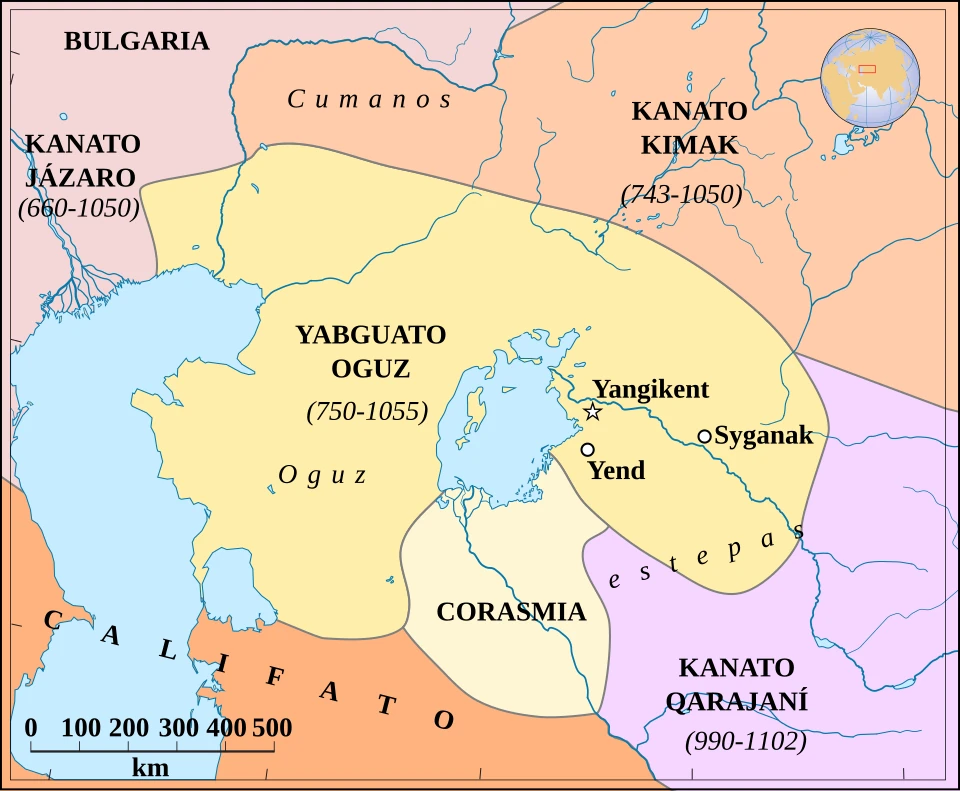
The Oghuz were a confederation of Turkic-speaking tribes who occupied the steppe north of the Aral Sea and along the Syr Darya river from roughly the eighth century onward. They were not a single people but a political grouping, traditionally counted as twenty-four tribes bound together by shared language, custom, and the authority of a paramount leader, the yabgu. Their name may have meant "tribes" or "clans," a label broad enough to accommodate the shifting alliances and absorptions that defined steppe politics.
From this confederation would eventually emerge the Seljuk Turks, who conquered much of the Islamic world in the eleventh century, and centuries later the Ottomans, who took Constantinople and built an empire spanning three continents. But in the period before 1000, the Oghuz were still nomads on the move, testing every border they touched.
The Oghuz heartland was the arid steppe between the Caspian and the Aral seas: flat, wind-scoured grassland shading into semi-desert, crossed by rivers that provided the only reliable water and the narrow strips of green pasture that sustained the herds. Summers were scorching, winters bitter, and the distance between useful waterholes could be measured in days of riding.
Life was pastoral and mobile. Families lived in felt yurts, moved with their sheep, horses, goats, and camels, and followed seasonal circuits between winter and summer pastures. A herder riding out at dawn to check on horses scattered across a dry valley floor worked in a landscape that offered no shelter, no shade, and no margin for carelessness. Camels carried the camp; horses carried the warriors; sheep provided meat, milk, wool, and the currency of bride-prices and blood-debts. A man without livestock was a man without standing, dependent on the charity of kinsmen or the wages of mercenary service.
Oghuz warfare was steppe warfare refined by generations of practice. Mounted archers harassed and encircled. Heavier cavalry closed for the kill once the enemy formation broke. The Oghuz were aggressive raiders who struck into the settled lands on their borders, taking what they needed and retreating before a response could be organized. Their speed in foreign territory was their greatest advantage: an Oghuz raiding column could appear, loot, and vanish before a garrison commander had finished reading the dispatch reporting its arrival.
The yabgu's authority depended on military success and the distribution of plunder. Tribes that received their share remained loyal; tribes that did not looked for a better leader. This made the confederation dynamic but unstable. Ambitious clan leaders broke away regularly, taking followers with them into the service of neighboring powers. Oghuz warriors served as mercenaries for the Samanids, the Abbasids, and other Islamic states, gaining experience, prestige, and converts along the way. The line between mercenary and conqueror was thin, and the Oghuz crossed it repeatedly.
The Oghuz of the early period followed the Tengri-based spiritual traditions common to the Turkic steppe world: sky worship, reverence for sacred mountains and springs, shamanic rituals involving drumming and trance. Conversion to Islam began along the edges of the confederation where contact with the settled Islamic world was most frequent, and proceeded gradually inward. A tribe on the frontier trading with Samanid merchants might adopt Islam within a generation; a tribe in the deep steppe interior might remain attached to older practices for another century.
The oral epic tradition of the Oghuz, preserved later in the Book of Dede Korkut, offers a picture of the values that shaped daily life. Hospitality was sacred and refusal was an insult. Courage in battle defined a man's worth. Women managed the household, could speak in council, and occasionally fought. A young man proved himself by performing a notable deed, after which he received his adult name. The epics describe a world of cattle raids, blood feuds, wedding feasts, and single combats at river crossings, a society that valued action over reflection and loyalty over cleverness.
The Oghuz sat at a crossroads. To the south lay the wealthy cities of Transoxiana, the Samanid state, and the wider Islamic world. To the north and east stretched the steppe, with its shifting alliances of Turkic and Mongol groups. To the west, the Khazar khaganate and beyond it the fringes of the Byzantine world. Trade passed through Oghuz territory in all directions: silk, horses, slaves, and the furs and hides of the northern forests.
The Oghuz legacy is measured not in monuments but in descendants. The Seljuk clan, originally a minor Oghuz family on the confederation's western fringe, converted to Islam and began the military expansion that would bring Turkic power into the heart of the Middle East. The Ottoman dynasty traced its lineage to the same Oghuz tribal tradition. Modern Turkmen, Azerbaijani, and Turkish peoples all descend linguistically and culturally from the Oghuz confederation. A herder on the Turkmen steppe today speaks a language that an Oghuz horseman of the ninth century would have partly understood.

 has +1 strength in a foreign

 , gain 1 experience cube
if you lost none of your
, gain 1 experience cube
if you lost none of your 

 , gain 1 corresponding
  from each hex of one chosen terrain type, or 3
  from each desert hex

 , then gain 1 Cavalryman
In the game, the Oghuz are the biggest rusher in the game. Armies hit harder in foreign territory, flawless victories earn experience, and explored provinces pay immediate resource dividends from the terrain. Put everything into early exploration; even cities and peasants can wait. Each new province feeds your momentum, and falling behind on expansion wastes the abilities that make you dangerous.
You choose one terrain type in the explored province and gain the matching resource from each hex of that type: wood from forest, stone from mountains, food from meadow or sea hexes.
Yes. Desert produces no resources, so instead you gain 3 coins per desert hex in that province. This is an alternative to choosing a resource-producing terrain type.
You choose one terrain type: either 2 food (from sea), or 2 stone (from mountains), or 9 coins (3 per desert hex). You cannot combine terrain types.
This is a starting setup modifier. You begin the game with 2 fewer peasants than normal but with 1 additional Cavalryman. It is not an action you perform during the game.
Yes. If your army is located in a foreign province, it receives +1 strength regardless of whether you are the attacker or the defender.