1-804 CE
The Saxons were a loose federation of Germanic clans who held the flat, boggy coastlands and sandy heaths between the Elbe and the Rhine, resisting Frankish conquest and Christian missionaries with a tenacity that took Charlemagne three decades of war to break.
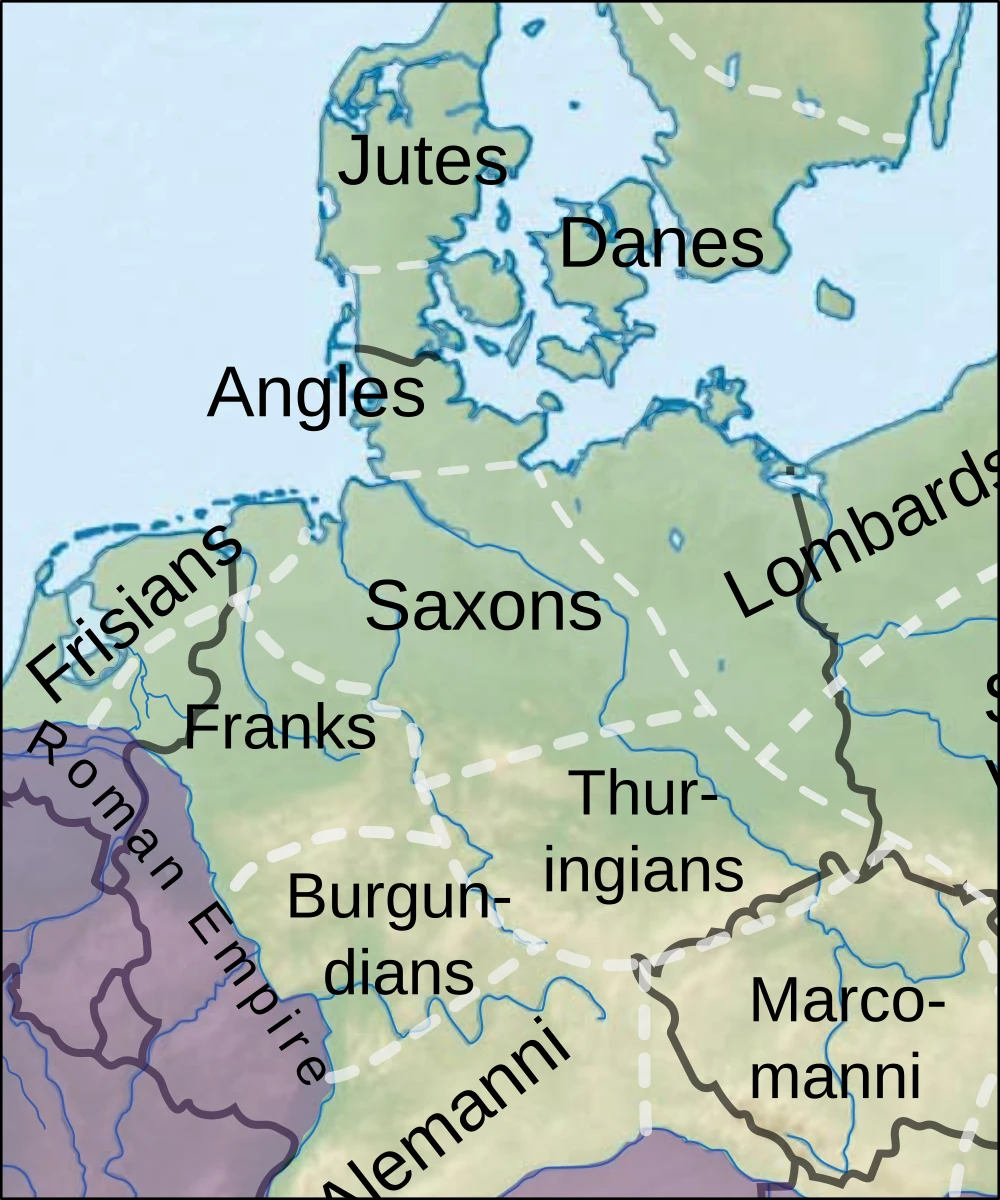
The Saxons were a group of Germanic-speaking peoples who occupied the low-lying country between the lower Rhine and the Elbe, stretching inland from the North Sea coast across sandy plains, heath, and bog. They enter the Roman record as coastal raiders in the third century, and their name may derive from the seax, a long single-edged knife that served as tool, weapon, and identity marker. Roman shore defenses in Britain and Gaul were organized specifically against them.
Unlike the Franks, who absorbed Roman structures and converted early, the Saxons remained stubbornly decentralized and pagan deep into the eighth century. Some crossed the North Sea to settle in Britain, but the majority stayed on the continent, farming the same thin soils their ancestors had worked, answering to no king.
Old Saxony was not generous land. The coastal strip was salt marsh and tidal flat, prone to flooding, useful mainly for grazing and salt extraction. Inland, the ground rose slightly into a landscape of sandy heath, peat bog, and patches of oak and beech forest. A farmer working this country grew rye and oats rather than wheat, kept cattle on the common pasture, and cut peat for fuel. The soil demanded patience more than skill.
Settlements were scattered: individual farmsteads or small clusters of longhouses, each surrounded by its own fields and fenced paddocks. There were no cities and almost no stone buildings. A Saxon homestead was timber, wattle, and thatch, rebuilt every generation or two as the posts rotted. The hearth sat at the center of the hall, and smoke found its own way out through the roof. Livestock wintered at one end of the same building. A woman spinning wool by firelight on a January evening shared the warmth with her husband's cattle and her children's coughs.
Saxon society was divided into three ranks: nobles, free men, and a dependent class bound to the land. There was no central king. Power rested with regional leaders and assemblies of free men who gathered at fixed meeting places to settle disputes and, in wartime, to elect a war-leader whose authority lasted only as long as the campaign. This made the Saxons almost impossible to defeat by treaty, since no single leader could surrender on behalf of all.
Charlemagne discovered this the hard way. His Saxon wars lasted from 772 to 804, a grinding sequence of invasions, forced baptisms, rebellions, and reprisals. He destroyed the Irminsul, a sacred pillar or tree-trunk that may have represented the axis of the world, in his first campaign. The Saxon leader Widukind resisted for years before finally accepting baptism around 785. Charlemagne's Capitulatio de partibus Saxoniae prescribed death for refusing baptism, eating meat during Lent, or cremating the dead. The conquest was as much religious as military, and the Saxons paid for their resistance with mass deportations and forced resettlement.
Saxon religion centered on sacred groves, open-air shrines, springs, and old trees. There was no priestly caste in any formal sense; rituals were led by local men of standing. The Irminsul, whatever its exact form, was important enough that its destruction by Frankish troops in 772 became a rallying point for decades of resistance. The dead were cremated with grave goods, a practice that missionaries worked hard to suppress and that persisted in remote areas well after official conversion.
Marriages were arranged between families of equal rank; intermarriage between the three social classes was forbidden by custom and later by Frankish-imposed law. Feud and wergild governed disputes. A killed man had a price in cattle or silver, and his kin were entitled to collect it or take revenge. Assemblies met seasonally at traditional sites, and attendance was both a right and an obligation for free men. The lack of written law before Frankish contact means most of what survives about Saxon custom comes from hostile Christian sources, but the outlines are clear: a conservative, kin-based society that valued local autonomy above everything else.
The Saxon migration to Britain in the fifth and sixth centuries carried a portion of the population across the North Sea, where they merged with Angles and Jutes to form the Anglo-Saxon world. Those who stayed on the continent remained in contact with Frisians to the west, Slavic peoples to the east, and Danes to the north. Trade moved along rivers and coastal routes: salt, cattle, furs, and slaves going out, Frankish metalwork and Rhenish wine coming in.
After conquest, Saxony was absorbed into the Carolingian Empire and eventually became one of the stem duchies of the medieval German kingdom. The region kept its name and a distinct identity. The Sachsenspiegel, a thirteenth-century law code, still reflected customs traceable to the pre-Frankish period. Lower Saxony, Saxony-Anhalt, the old place-names and parish boundaries: the map of northern Germany still carries the outline of a people who wanted nothing more than to be left alone and nearly succeeded.

 /
/  , they must draw +1 cube
from the bag
, they must draw +1 cube
from the bag


 with
with  located
in a forest deals at least 1 damage,
deal 1 extra damage to the same target
located
in a forest deals at least 1 damage,
deal 1 extra damage to the same target


 and 1
and 1  for each
of your experience cubes
for each
of your experience cubes


 that received
the most votes, gain 1 blessing effect
from any other instead
that received
the most votes, gain 1 blessing effect
from any other instead
In the game, the Saxons dig in and refuse to budge. Opponents spreading religion into your territory must draw extra cubes, the kind of resistance that cost Charlemagne thirty years of war. The forest makes your melee units lethal, experience cubes feed your economy, and you cherry-pick blessings from events others voted for. Settle deep in forested provinces early and accumulate experience cubes rather than spending them. Your late game scales with the experience you hoard.
No, only +1 cube. The ability triggers once per spread attempt. Your province and your religious community within it do not stack. The opponent draws +1 extra cube total regardless of whether both your province and your religious community are in the target area.
No. The ability requires your army with melee units to be located in a forest. Your units' position matters, not the enemy's.
No. The ability triggers only if your army deals at least 1 damage. If no damage is dealt during the battle, the additional 1 damage does not apply.
When the event that received the most votes is resolved, you gain 1 blessing effect from any other event card instead of one of the winning event's effects. You still receive the winning event's other effects normally.
Yes. The ability says "any other event," which includes event cards in the grid that were not eligible for voting this round.