1-496 CE
The Alemanni were a confederation of Germanic war-bands who settled the upper Rhine and the highlands between the Black Forest and the Alps, raiding Roman territory for two centuries before carving out a homeland in the ruins of the frontier provinces.
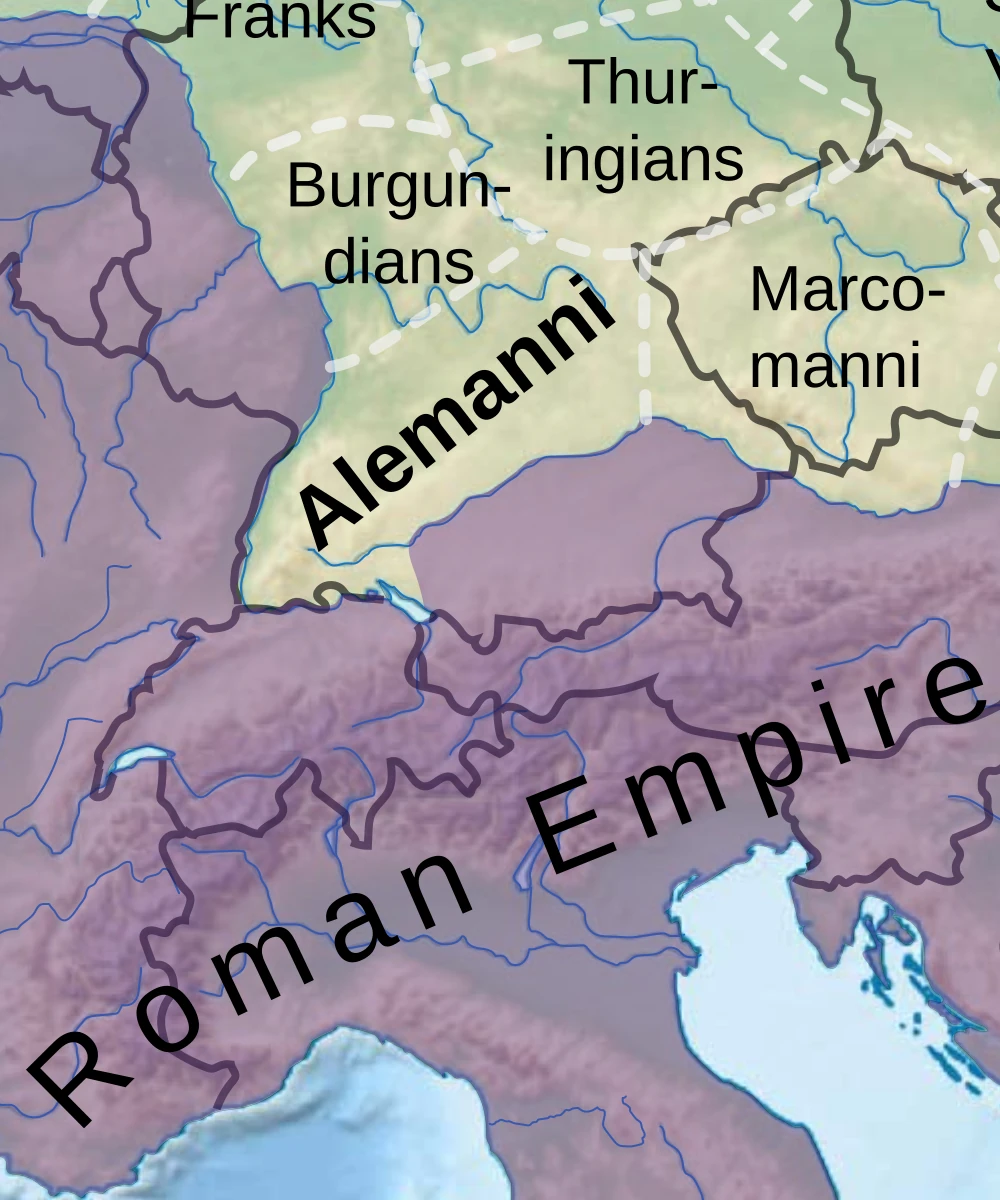
The Alemanni were a confederation of Germanic-speaking groups who coalesced along the upper Rhine sometime in the third century. The name, usually read as "all men," suggests a mixed origin: not a single tribe with a shared ancestor-myth but a gathering of smaller bands, refugees, opportunists, and splinter groups drawn together by proximity and the shared project of raiding the Roman frontier. Roman writers used the name loosely, sometimes for a specific enemy, sometimes for any Germans east of the Rhine who caused trouble.
They were never an empire and never wanted to be one. What held them together was a landscape, a military style, and a stubbornness that outlasted Rome itself.
Their territory occupied the ground between the upper Rhine, the Danube headwaters, and the northern edge of the Alps: rolling uplands, deep forest, river valleys with good soil along the bottomlands. When Roman legions withdrew from the Agri Decumates in the mid-third century, Alemannic settlers moved into the abandoned farmsteads and fort sites. They inherited cleared land, stone foundations, sometimes even functioning bathhouses, though they had little use for those.
A family compound consisted of a timber longhouse with cattle stalls at one end and a hearth at the other, surrounded by smaller outbuildings for storage and craft. Barley and spelt grew in the valley fields. Pigs foraged in the beech forests. A woman grinding grain on a hand-quern in the doorway of her house on a November morning would have looked out at a landscape that was half wilderness and half Roman ruin, old wall-lines running through pastures where her goats grazed. Ironworking was local and competent; Alemannic smiths turned out tools, weapons, and the heavy brooches that fastened cloaks at the shoulder.
The Alemanni were raiders before they were settlers. Through the third and fourth centuries they crossed the Rhine repeatedly, sometimes in large coordinated attacks, sometimes in small bands looking for cattle and portable wealth. Roman emperors campaigned against them with regularity. Julian fought them near Strasbourg in 357 and won a decisive victory, but decisive victories against the Alemanni had a way of needing repetition a decade later.
Leadership was distributed. Multiple kings and war-leaders operated simultaneously, which made the confederation hard to destroy but also hard to unite. No single ruler could commit the whole people to a treaty, and no single defeat knocked them out. This loose structure worked well for raiding and frontier skirmishing but poorly against a centralized enemy willing to keep coming. When the Frankish king Clovis defeated the Alemanni at Tolbiac around 496, the confederation had no mechanism for organized recovery. Alemannic territory was absorbed into the Frankish kingdom, and the people survived as a regional identity within it.
The Alemanni remained pagan longer than most of their neighbors. Sacred groves, hilltop shrines, and offerings deposited in rivers and bogs persisted well into the sixth century, long after Frankish overlords had officially imposed Christianity. Missionaries found the highlands difficult and the population uninterested. Conversion, when it came, was slow, piecemeal, and flavored with older practices that never quite disappeared. A wooden cross might stand at a spring where offerings had been left for generations, and the locals saw no contradiction.
Free men gathered in assemblies to settle disputes, allocate grazing rights, and decide whether to follow a war-leader on a raid. Social rank was real but not rigid: a successful fighter could rise, a failed leader could be abandoned. Women managed households, controlled stored food and textile production, and were buried with keys, spindle whorls, and elaborate bead necklaces that marked their status. The dead were interred with weapons, jewelry, and sometimes food vessels, suggesting expectations about an afterlife that required provisions.
For two centuries the Alemanni and the Roman Empire existed in a state of mutual hostility punctuated by trade. Roman coins, glassware, and pottery flowed across the frontier in exchange for cattle, hides, and amber. Alemannic warriors served as Roman mercenaries, learned Roman tactics, and brought that knowledge home. The relationship was parasitic in both directions: Rome needed Germanic recruits, and the Alemanni needed Roman goods that their own economy could not produce.
After absorption into the Frankish kingdom, the Alemannic identity survived as a regional label. The territory they had settled became the duchy of Swabia in the medieval period. Their name lives on in the French and Spanish words for Germany itself: Allemagne, Alemania. To the Romance-speaking world, all Germans are still Alemanni, a memory of the people who stood on the other side of the Rhine when the frontier still meant something.


 in your
  unless their
  has at least 3


 and -2
  for each, but immediately inflict 1 damage to each of these Buildings

 /
/  per engaged
In the game, the Alemanni level the playing field. Opponents cannot stack extra cubes in battle, so expensive armies fight on your terms. Buildings go up cheap but damaged, settlers raising rough walls on Roman ruins rather than quarrying fresh stone. Melee units forage resources from meadow and forest as they move, keeping your economy running mid-campaign. Focus on early aggression while your battle restriction hurts opponents the most, and use Overcome to repair your discount buildings before they become a target to your enemies.
No. The ability limits opponents to adding no more than 1 cube total from action, experience, and voting cubes combined. They must choose one, not one of each type.
No. If your opponent has already added 1 cube (of any type listed in the ability), they cannot add any additional action, experience, or voting cubes from other sources such as Autocracy's ability.
No. The ability requires the army to have at least 3 military units. This refers to the number of units in the army, not their total influence or HP. Two Galleys are an army of size 2, which does not meet the requirement regardless of their combined stats.
No. The ability specifies "when constructing Buildings." Cities are not Buildings. Only buildings such as workshops, forges, and similar structures qualify for the -1 stone / -2 coins discount and the associated damage.
Yes. Overcome is a free action that can be performed before or after your main action. You may construct buildings with the discount, accept the damage, and then immediately Overcome to repair them in the same turn.
After completing a maneuver with your melee units to a meadow or forest hex, you gain 2 food (meadow) or 2 wood (forest) for each engaged melee unit, but only if you did not start a battle. This rewards peaceful movement and positioning. The bonus is per melee unit, so moving 3 melee units to a forest hex without fighting gives you 6 wood.