370-469 CE
The Huns were mounted warriors from the Central Asian steppe who erupted into Europe in the late fourth century, shattering every kingdom in their path and building a nomadic empire that terrified the Roman world before vanishing almost as suddenly as it had appeared.
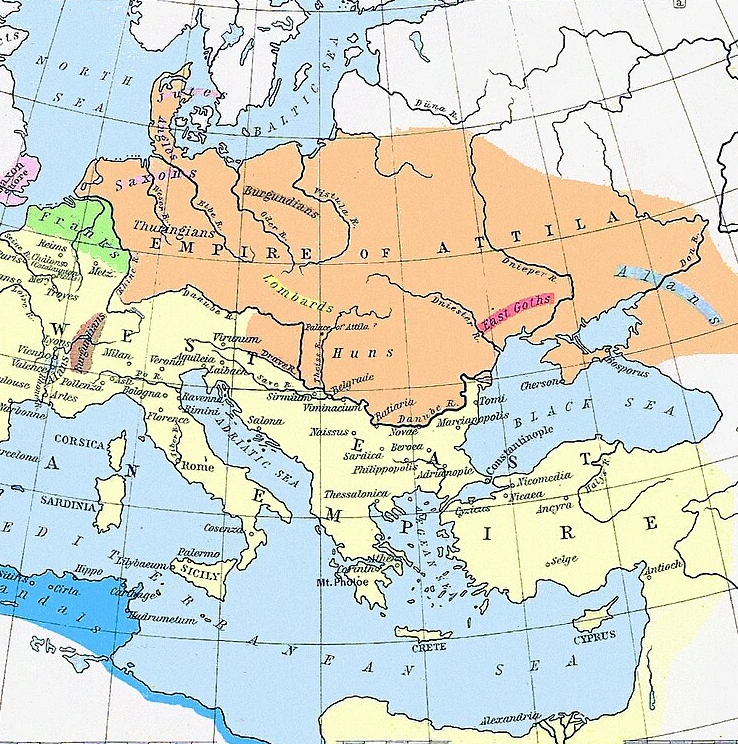
The Huns came out of the steppe east of the Volga in the 370s and hit the settled and semi-settled peoples of Europe like a thrown stone hitting a window. Their origins are obscure: possibly connected to the Xiongnu of Chinese records, possibly not. What matters is what they did. Within a generation of their appearance they had crushed the Alans, shattered the Ostrogothic kingdom on the Black Sea steppe, and driven the Visigoths across the Danube into Roman territory, setting off the chain of migrations that would eventually pull the Western Roman Empire apart.
They were not a single ethnic group but a military confederation held together by success. Conquered peoples, Gothic warriors, Alan cavalry, Gepid infantry, all rode under the Hunnic banner as long as the plunder kept coming.
The Huns had no homeland in the settled sense. Home was the wagon, the herd, and the next stretch of grass. Roman observers described them with a mix of horror and fascination: they ate raw meat softened under their saddles, slept on horseback, and conducted diplomacy from the backs of their ponies. Some of this was propaganda, but the core was real. The Huns were steppe nomads whose entire economy was portable. Horses, cattle, sheep, and goats moved with the camp. Felt tents went up in the evening and came down at dawn.
When they settled in the Hungarian plain in the early fifth century, they adapted only slightly. The grasslands of the Carpathian basin resembled the steppe they had left behind, and the Huns used the region as a base for raiding rather than farming it. A Hunnic camp on the Tisza river in the 440s was a sprawl of tents, wagons, and corralled horses surrounding a timber hall where Attila received ambassadors. The Roman diplomat Priscus, who visited in 449, described a court that mixed steppe simplicity with captured Roman luxury: gold cups, silk hangings, and a wooden bathhouse built by a Roman prisoner of war.
Hunnic warfare was built on the composite bow and the small, tough steppe horse. A Hunnic rider could shoot accurately at full gallop, turn in the saddle to fire behind him, and keep up the pressure for hours. Armies that tried to close with the Huns found themselves riddled with arrows before they could make contact. Armies that stood still were circled and worn down. The Huns added siege capability as they moved west, learning from Roman and Gothic engineers how to take walled cities, a skill that pure steppe armies usually lacked.
Attila consolidated Hunnic power in the 430s and 440s, extracting enormous tribute from Constantinople and raiding deep into the Balkans. His invasion of Gaul in 451 was stopped at the Catalaunian Plains by a coalition of Romans and Visigoths, one of the few battles where Hunnic cavalry met a force large and disciplined enough to hold. Attila invaded Italy the following year, reached the Po valley, and withdrew, possibly because plague and supply problems made continuing impossible. He died in 453, and without him the empire flew apart. His sons quarreled, subject peoples revolted, and within fifteen years the Huns had ceased to exist as a political entity.
Almost nothing is known about Hunnic religion from Hunnic sources, because they left none. Roman and Gothic writers mention shamans, divination by examining animal entrails, and veneration of a sacred sword that Attila claimed represented the war god. Funeral rites for important leaders involved feasting, ritual scarification of mourners' faces, and horse sacrifices. A warrior cut his own cheeks with a blade so that the dead leader would be honored with blood rather than tears.
Hunnic society was organized around the warband and the clan. Loyalty ran upward to the leader who distributed plunder and downward to the warriors who earned it. There was no written law, no priesthood in any formal sense, and no permanent institutions beyond the personal authority of the chief. When the chief died, the structure died with him. A woman in a Hunnic camp held authority over the household economy and could exercise considerable informal power, but the public world was defined entirely by mounted men and the hierarchy of violence that organized them.
The Huns' lasting impact was indirect. By driving the Goths, Vandals, Alans, and other peoples westward, they set in motion the migrations that reshaped the Roman Empire. The political map of fifth-century Europe was drawn by peoples fleeing the Huns as much as by the Huns themselves. The tribute extracted from Constantinople transferred enormous quantities of Roman gold onto the steppe, and Hunnic-era gold finds across eastern Europe testify to the scale of the transfer.
After Attila's death the Huns dispersed into the populations around them. Some merged with Gepids and Goths in the Carpathian basin. Others drifted back toward the steppe. No Hunnic language, literature, or distinctive art style survived. What survived was the memory: Attila became a figure of legend in both Germanic and Latin tradition, a byword for destructive power, and a permanent reminder that the steppe could produce forces that no wall, no treaty, and no army could reliably contain.

 have +1 strength bonus vs


 for each destroyed enemy object
 with 3 movement points. During this, you may explore a
  , move to a hex adjacent
to another City, and, as part of your
, move to a hex adjacent
to another City, and, as part of your  , initiate a battle
, gain 1 exhausted Cavalryman in that
, initiate a battle
, gain 1 exhausted Cavalryman in that
In the game, the Huns never sit still. Your city moves with 3 movement points, explored provinces spawn free cavalry, destroyed objects yield resources, and cavalry smash structures. Keep your city advancing behind your armies and explore aggressively for free riders. Almost all your abilities expire after Age I, mirroring how the Huns blazed across history and vanished just as fast. Seize your advantage in the first rounds or watch it disappear.
Only as part of an army. Marching requires military units, so if your City maneuvers together with an army, the army can march. A City maneuvering alone cannot march.
It can move through such hexes but cannot stop there. Only one structure can occupy a hex. Your City can pass through hexes with your buildings during movement but must end on a valid hex.
No. Only an army can initiate a battle, and an army requires at least one military unit. A City maneuvering alone can explore and move but cannot start battles.
Yes. The City becomes exhausted after maneuvering, just like any other unit. It cannot maneuver again until the exhaustion is removed.
Yes. The City follows the same ferry rules as regular units when being transported by vessels.
No. Adversity cubes on a City represent damage only, never rebel status. Cities cannot become rebels.
No. The City is still a structure, not a unit. It merely has the ability to perform maneuvers. Conversion and recovery actions only apply to actual units.
In the newly explored province. The cavalryman is placed on any hex within that province and arrives exhausted, so it cannot move until the next round.